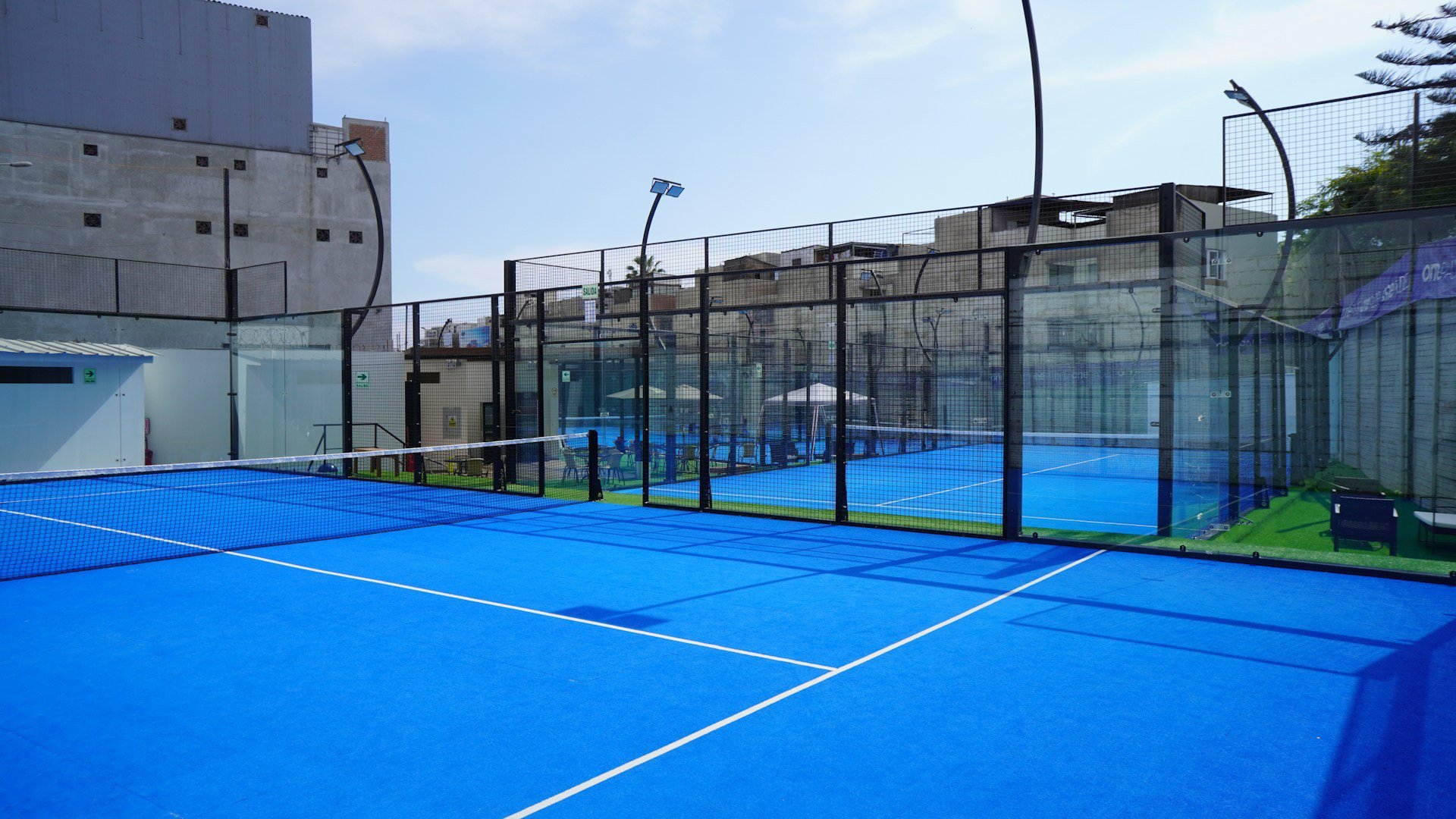
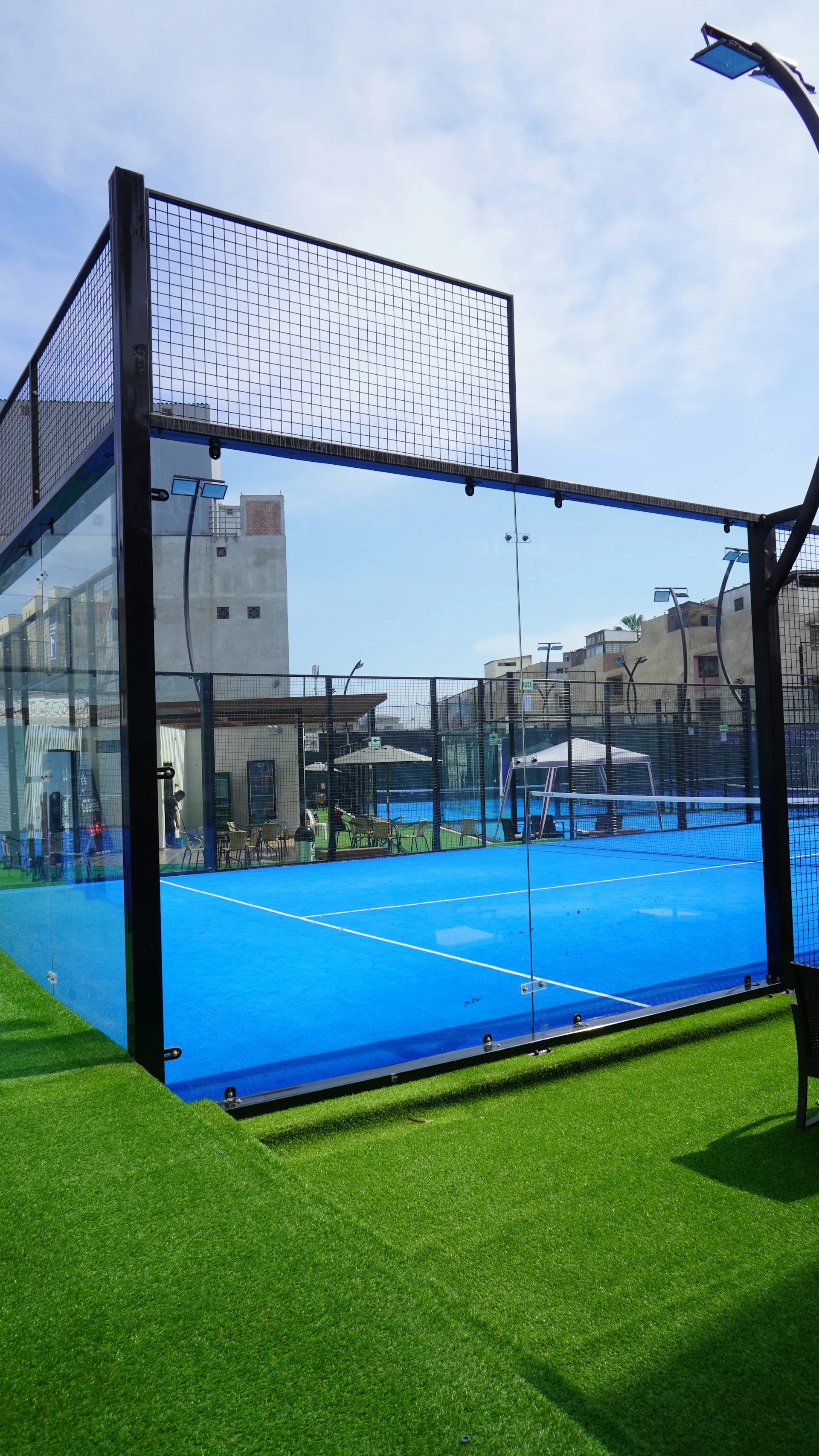
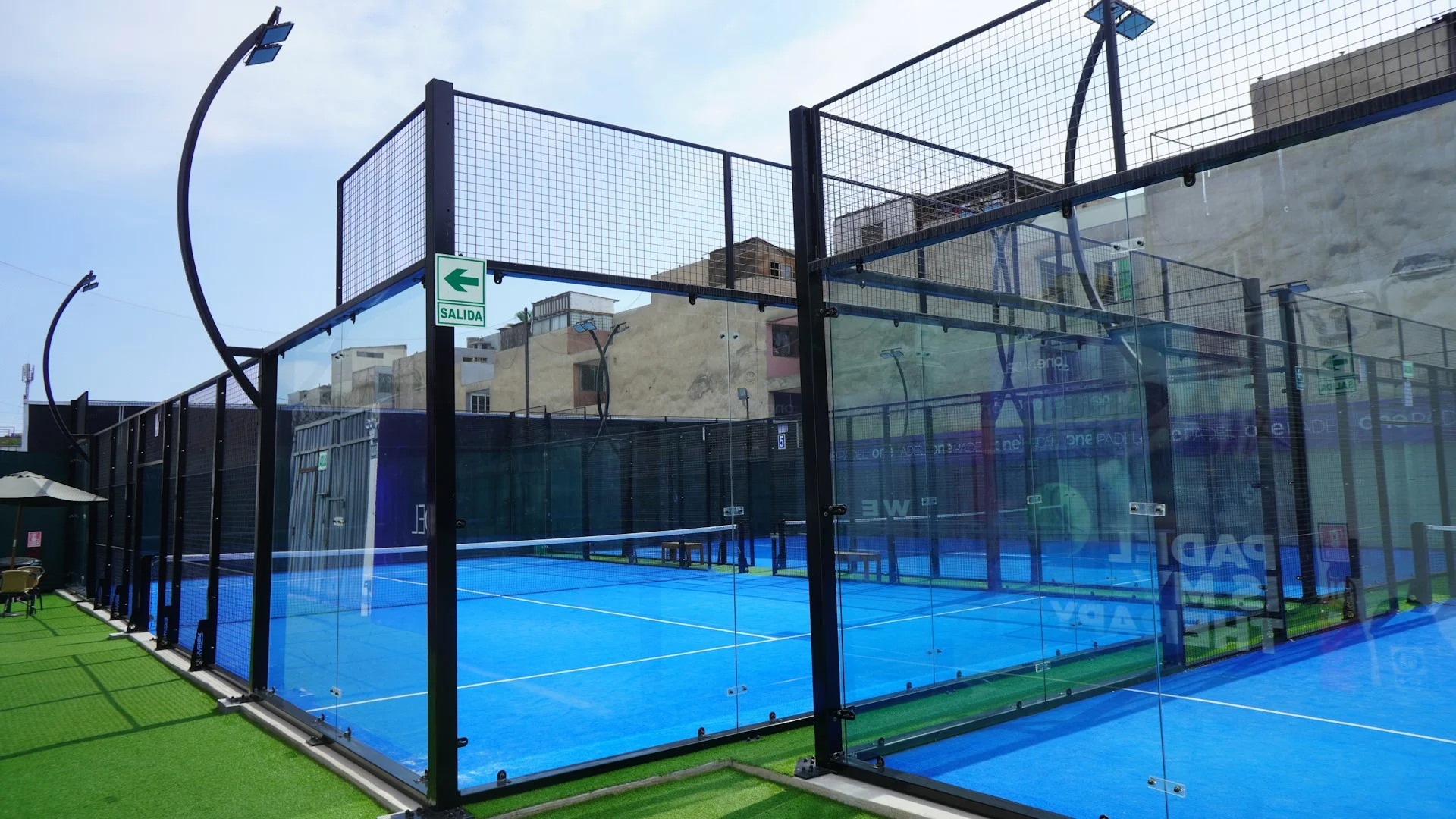
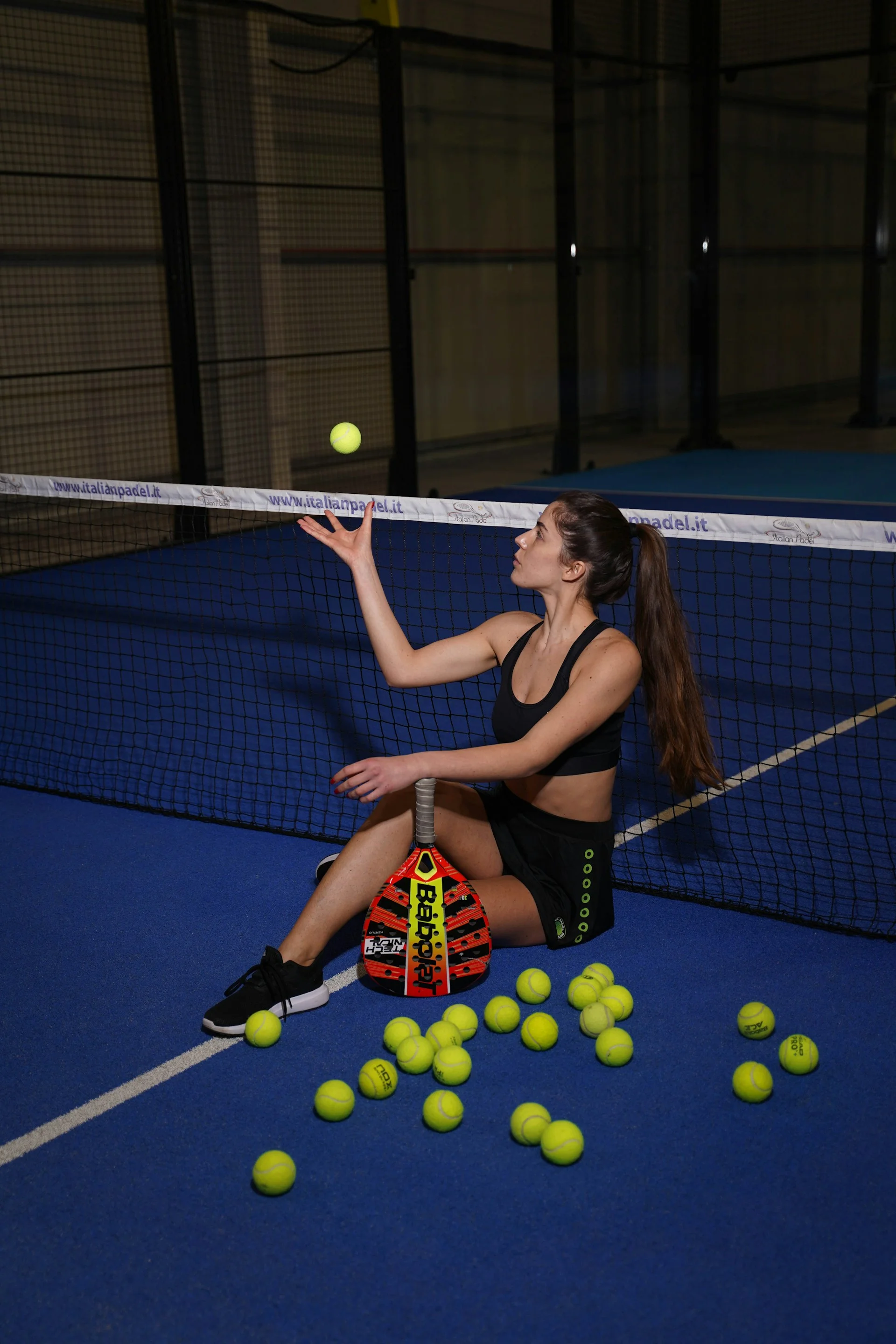
Padel (pádel) is a racket sport that combines elements of tennis and squash. It is played on an enclosed court in doubles format and is known for its accessibility, dynamic gameplay, and strong social appeal.
Photo: Bruno Vaccaro Vercellino / UnsplashPhoto: Bruno Vaccaro Vercellino / Unsplash / Unsplash License
Definition
Padel is a team racket sport in which two players face off against two others on a compact court surrounded by walls made of glass and metallic mesh. Unlike tennis, the ball can bounce off the walls and remain in play, adding strategic depth and dynamics reminiscent of squash. The padel racket is solid (no strings), with a perforated surface, which makes ball control more predictable for beginners.
Padel combines the tactical thinking of tennis, the wall play of squash, and the social atmosphere characteristic of team sports. It is this unique combination that makes it one of the fastest-growing sports in the world.
Brief History
Padel was invented in 1969 by Mexican entrepreneur Enrique Corcuera in Acapulco, Mexico. Corcuera enclosed a playing area at his home with walls, creating the first padel court. He adapted tennis rules to the new format: a compact space, underhand serve, and wall play.
In 1974, Alfonso de Hohenlohe-Langenburg, having visited Mexico and discovered padel, built the first two courts in Spain at the Marbella Club on the Costa del Sol. Spain became the main hub for padel’s development and remains so to this day.
In 1991, the International Padel Federation (FIP) was founded. It now unites approximately 100 national federations and organizes world championships.
Padel has several defining features that set it apart from other racket sports:
Doubles format. Padel is played exclusively as 2 vs 2. This makes the sport inherently social and team-oriented.
Enclosed court with walls. The court is surrounded by a combination of glass walls and metallic mesh. A ball that bounces off the wall after hitting the floor remains in play.
Underhand serve. Unlike tennis, the serve must be hit from below waist height. This lowers the barrier to entry and levels the playing field between players of different skill levels.
Solid racket. The padel racket has no strings — it is made from composite materials with a perforated surface.
Strategy and positioning. Due to the walls and compact court, positional play and tactics matter more than raw hitting power.
The Padel Court
The padel court is a rectangular playing area measuring 10 by 20 meters, divided by a net into two equal halves.
Key court specifications:
Dimensions: 10 m wide, 20 m long
Walls: back walls 4 m high (typically glass), side walls — a combination of glass (3 m) and metallic mesh (1 m on top)
Surface: artificial grass with sand infill or concrete
Net: 88 cm high at the center, up to 92 cm at the posts
Service boxes: similar to tennis, positioned diagonally
The court is significantly smaller than a tennis court (which measures 10.97 by 23.77 m for doubles), reducing the physical endurance requirements and allowing players to enjoy the game from the very first session.
Why Padel is Growing
Padel is experiencing explosive growth in popularity worldwide. Several factors contribute to this trend:
Low barrier to entry. Thanks to the underhand serve, compact court, and solid racket, beginners start enjoying the game after their very first session. Years of training are not required to reach a basic level.
Social nature. The 2 vs 2 format makes padel an ideal way to spend time with friends, colleagues, or family. The atmosphere on the court is less formal than in tennis.
Accessibility. A compact court requires less space and investment to build than a tennis court. Padel clubs are appearing in urban areas where a full-size tennis facility would be impossible.
Physical activity without excessive strain. Padel provides a solid cardio workout and develops coordination while being gentler on joints than tennis, thanks to the smaller court and less aggressive movements.
Entertainment value. Fast-paced rallies, wall play, and team dynamics make padel engaging both for players and spectators.
Padel by the Numbers
The scale of padel’s spread is impressive (FIP World Padel Report 2025):
Over 35 million active players worldwide
Approximately 100 national federations within FIP
More than 77,000 courts in 150 countries
Padel is recognized as the fastest-growing sport in Europe by the rate of new player growth
Premier Padel and World Padel Tour are the largest professional tours, broadcast internationally
Where Padel is Most Popular
Padel’s development is uneven across the globe, but its geographic reach is expanding rapidly:
Spain — the undisputed leader: over 6 million players, padel is the second most popular sport after football
Argentina — home to many top professional players, padel is deeply rooted in the country’s sports culture
Italy — one of the fastest-growing markets in Europe, with the number of courts doubling every few years
Sweden — the Scandinavian leader, padel is popular in both indoor and outdoor formats
UAE and Qatar — actively investing in padel infrastructure and hosting international tournaments
Russia and CIS — an early-stage market, but the number of clubs and players is growing
[UNVERIFIED] Among the new regions of active growth are the United Kingdom, Germany, the Netherlands, Belgium, and Asian countries including Japan, South Korea, and India.
How to Get Started
Getting started with padel requires minimal preparation:
Find a nearby club with padel courts
Rent a racket (most clubs provide equipment for beginners)
Wear athletic shoes with non-slip soles
Find partners — you need 4 people for a full game
Start with basic strokes and the serve — an instructor can teach you the fundamentals in a single session
Padel and tennis are related racket sports, but there are fundamental differences between them: from court dimensions and racket type to serving rules and game format. Understanding these differences will help tennis players adapt to padel more quickly, and newcomers choose the right sport.
Photo: Bruno Vaccaro Vercellino / UnsplashPhoto: Bruno Vaccaro Vercellino / Unsplash / Unsplash License
Quick Comparison Table
Parameter
Padel
Tennis
Court
10 x 20 m, enclosed by walls
23.77 x 10.97 m (doubles), open
Walls
Yes, ball can be played off walls
No
Racket
Solid, no strings, perforated
Strung, oval head
Ball
Slightly lower pressure
Standard pressure
Serve
Underhand, below waist level
Overhead
Scoring
15, 30, 40 (often golden point)
15, 30, 40 (classic deuce/advantage)
Format
Doubles only (2 vs 2)
Singles and doubles
Physical demands
Less running, more tactical
More running and athleticism
Learning curve
Low, easy to start
Medium, requires technique
Court: Enclosed vs Open
One of the most visible differences is the court itself. A padel court is significantly more compact than a tennis court: it measures 10 x 20 meters, while a doubles tennis court is 23.77 x 10.97 meters. The tennis court area is roughly one and a half times larger.
The defining feature of a padel court is its walls. The court is enclosed on all sides: back walls (usually made of glass or concrete, 3-4 meters high) and side walls with metal mesh. A ball that bounces off a wall remains in play — this is a fundamental part of padel rules, entirely absent in tennis. For more details on court specifications, see court dimensions and markings.
Racket: Solid vs Strung
Tennis uses a racket with a strung hitting surface and a long handle (total length up to 73.7 cm). The strings create a trampoline effect and allow players to generate significant spin.
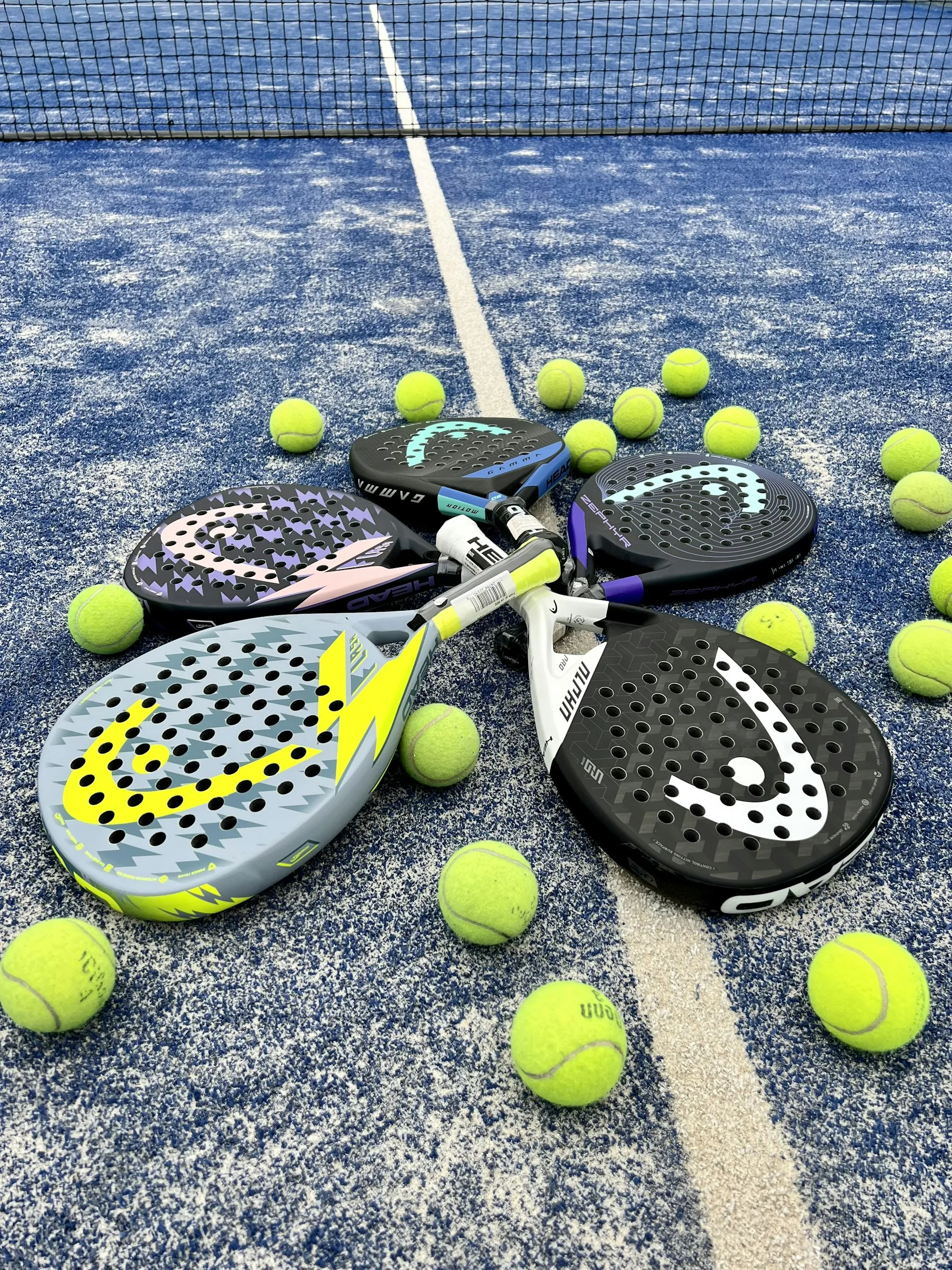
The padel racket is fundamentally different: it is a solid construction made from composite materials (carbon fiber, fiberglass) with a foam core (EVA or FOAM). Instead of strings, the hitting surface has perforations (holes). A padel racket is up to 45.5 cm long and typically weighs 340-380 grams. An unstrung tennis racket weighs 260-340 grams. For a more detailed guide on racket selection, read how to choose a racket.
Ball: Almost Identical, but Not Quite
At first glance, padel and tennis balls are virtually indistinguishable. They are the same size and color. However, a padel ball has slightly lower internal pressure (4.6-5.2 kg/cm² versus 5.6-6.3 kg/cm² for a tennis ball). This means the padel ball bounces slightly lower, making the game more controlled on a compact court with walls.
In practice, many recreational players use tennis balls for padel, but at the professional level the pressure difference plays a significant role.
Serve: Underhand vs Overhead
In tennis, the serve is one of the most powerful shots. The player tosses the ball and strikes it overhead, with professional serve speeds reaching 200-250 km/h. The serve in tennis is often a decisive weapon.
In padel, it is the opposite: the serve must be performed underhand. The ball must bounce on the ground first, and the strike must occur below waist level. This makes the serve a far less aggressive element of the game. In padel, the serve functions more as a way to start the rally rather than a means of scoring directly. For more on serving rules, see serving rules.
Scoring: Similar, but with Nuances
The basic scoring system in padel and tennis is identical: 15, 30, 40, game. A set is played to 6 games with a tiebreak at 6-6. A match is typically played as best of three sets.
The key difference is the golden point (punto de oro). At many padel tournaments, when the score reaches deuce, a single decisive point is played instead of the classic advantage system. The receiving pair chooses which side to receive from. The golden point speeds up play and adds drama.
Game Format: Doubles Only
Tennis offers both singles and doubles formats. Padel is played exclusively in doubles — 2 vs 2. This is one of the sport’s defining characteristics. Singles padel exists as an unofficial format, but standard courts and rules are designed for four players.
The doubles format shapes the tactics: coordination with your partner, positional play, and on-court communication are critically important skills. Learn more about the fundamentals in our article what is padel.
Walls: Padel’s Unique Element
The use of walls is what makes padel a truly unique sport. After bouncing off the floor, the ball may hit the back or side wall, and the player is allowed to play it after such a bounce. Moreover, in certain situations a player can hit the ball out of the court over the side wall and return it from outside (the so-called “salida de pared” or “going outside the court”).
This mechanic adds an extra dimension of tactics. Shots that would be winners in tennis can be “saved” off the wall in padel. This makes rallies longer and more spectacular.
Physical Demands
Tennis is an extremely athletic sport. The large court requires intensive movement: sprints, sharp changes of direction, and long lunges toward the ball. Professional tennis matches can last several hours and demand outstanding endurance.
Padel, thanks to its compact court, requires less running. However, this does not mean padel is less intense. The emphasis shifts to quick reactions, reflexes, shot precision, and tactical thinking. The physical load in padel is more evenly distributed and puts less stress on joints, making the sport accessible to a wide age range.
Learning Curve
[EXPERT OPINION] Padel is considered one of the most accessible racket sports for beginners. The compact court, underhand serve, solid racket, and walls that “help” keep the ball in play — all of this allows newcomers to enjoy the game from the very first minutes.
In tennis, the learning curve is considerably steeper. Comfortable play requires mastering basic stroke technique, learning to control a strung racket, and developing sufficient fitness to move around a large court. This typically takes months of regular practice.
The doubles format makes padel inherently more social. There are always four people on court, creating a relaxed and friendly atmosphere. Many padel clubs organize the “americano” format — tournaments with rotating partners, which encourages meeting new people and expanding your social circle.
Tennis, especially in singles, is a more individual sport. Although doubles tennis exists, padel culture is built from the ground up around playing together and socializing.
Who Is Padel Right For
Padel is especially suitable for:
Former tennis players — basic racket sport skills transfer easily
Beginners — low barrier to entry, quick progress
Older adults — less stress on joints
Those seeking a social sport — doubles format and club culture
Padel is one of the most accessible racket sports. To start playing, all you need is minimal equipment, a partner, and a willingness to move. This article is a step-by-step guide for anyone looking to step onto the court for the first time.
You do not need much for your first time on the court. Here is the essentials checklist:
A padel racket. Most clubs offer racket rental for your first session — a great option to try the sport without spending upfront. A padel racket is shorter than a tennis racket, has no strings, and is made of composite materials with a perforated surface.
Balls. Padel balls look similar to tennis balls but have slightly lower pressure, resulting in a lower bounce. Usually balls are provided by the club or split among players.
Sports shoes. Ideally, specialized padel shoes with a herringbone sole that provides excellent grip on artificial grass. For your first few sessions, any indoor court shoes with non-slip soles will work. Avoid running shoes — they lack lateral support.
Comfortable sportswear. No special requirements — shorts and a t-shirt or tracksuit depending on the weather.
[EXPERT OPINION] For beginners, round-shaped or teardrop-shaped rackets with a soft EVA core are the best choice — they offer more control and are forgiving on off-center hits. Do not spend more than 50-80 EUR on your first racket — at the beginner level, the difference between a budget and premium model is barely noticeable. For more details, see How to Choose a Racket.
Where to Find a Court
Padel is growing rapidly, and courts are appearing in more and more cities:
Dedicated padel clubs — the best option. They offer coaching, equipment rental, and a community of players.
Multi-sport centers — many tennis clubs are adding padel courts to their facilities.
Booking apps. Services like Playtomic, Matchi, and local alternatives let you find nearby courts, book time slots, and even find playing partners.
If there is no padel court in your area yet, keep an eye out — the number of facilities is growing every year worldwide.
First Steps: Where to Begin
The most common mistake beginners make is jumping straight into a match. Instead, we recommend starting with structured instruction:
Group lesson — the optimal starting point. A coach will explain the basic rules, show you the grip, stance, and fundamental strokes. In a group of 4-8 people, you will be among fellow beginners, which removes the psychological barrier.
Private lesson — if you want faster progress or feel self-conscious in a group. Typically, 2-3 private sessions are enough to learn the basics.
Playing with an experienced friend — if your friend is willing to patiently show you the ropes, this works too, but a coach is more efficient.
After 3-5 training sessions, you can start playing full matches.
Basic Skills to Learn First
Padel is easier to pick up than tennis, but the foundation is built right at the beginning:
Grip. The continental grip is the standard in padel. Hold the racket as if you are shaking hands with it. This grip allows you to execute most shots without switching.
Ready position. Face the net, feet shoulder-width apart, knees slightly bent, racket held in front of you at chest level. From this position, you can react quickly to any ball.
Forehand and backhand. The two fundamental strokes from the right and left sides. In padel, the swing is shorter than in tennis, and control matters more than power.
Serve. In padel, the serve is underhand — the ball must bounce on the ground before being struck with the racket. This is significantly easier than a tennis serve and is accessible from the very first lesson.
Playing off the walls. The unique feature of padel — the ball can bounce off the glass walls. Learning to read wall bounces is a key skill that develops with practice.
Padel is a social and partner-based sport. Knowing the etiquette will help you integrate into the community faster:
Communicate with your partner. Padel is a team game (2 vs 2). Agree on who takes the ball, encourage each other. Calling “Mine!” or “Yours!” is standard practice.
Collect the balls. After each point, gather the balls on your side and pass them to the serving team. Do not hit balls across the court — roll or toss them gently.
Switch sides. Players change sides after every odd game (after the 1st, 3rd, 5th, etc.).
Respect the time. Arrive on time — court time is usually limited. If you are running late, let the others know.
Be friendly. Padel is valued for its welcoming atmosphere. Do not criticize your partner for mistakes, especially when playing with a beginner.
How Much Does It Cost
Approximate costs to help you plan your budget:
Expense
Approximate Cost
Court rental (1 hour)
20-60 EUR (for 4 players)
Racket rental
3-5 EUR per session
Buying a racket (beginner level)
30-80 EUR
Balls (can of 3)
5-10 EUR
Group lesson
10-25 EUR per person
Private lesson
30-60 EUR (45-60 min)
Padel shoes
50-150 EUR
[UNVERIFIED] Prices can vary significantly depending on the region and the level of the club. Data is approximate as of early 2026 for Western Europe.
Per player, court rental works out to 5-15 EUR per hour — comparable to other sports.
Tips for Tennis Players
If you already play tennis, you have a significant advantage — coordination, ball sense, and an understanding of racket sports. But there are key differences to adapt to:
Shorten your swing. In padel, the walls limit space and the racket is shorter — a long tennis swing will get in the way.
Underhand serve. Forget about the powerful overhead serve — padel only allows underhand serving. Focus on accuracy and spin instead.
Walls are your friend. A ball heading toward the wall is not out — it is a continuation of the rally. Learn to wait for the wall bounce instead of trying to intercept every ball in the air.
Net position. In padel, the winning position is at the net, not at the baseline. Aim to take a position closer to the net together with your partner.
Less power, more tactics. Padel is a placement game, not a power game. A well-placed lob is more effective than a powerful smash.
Tips for Complete Non-Athletes
Never played a racket sport before? That is not a problem:
Padel is made for everyone. The court is smaller than a tennis court, the serve is easier, and the walls keep the ball in play longer. Rallies are longer — you have more time to react.
Start with coordination. In your first sessions, the coach will work on making contact with the ball and basic movement. Do not aim for complex shots right away.
Do not compare yourself to others. Everyone progresses at their own pace. Many beginners play comfortably after 5-10 sessions.
Build fitness gradually. Padel is a good cardio workout. If you have not exercised in a while, start with 30-40 minutes on the court and increase gradually.
Warm up. Before playing, spend 5-10 minutes on a light warm-up — joint mobility, light jogging, stretching. This will reduce the risk of injury.
Building a Regular Playing Routine
Consistency matters more than intensity. Here is how to make padel part of your routine:
Play 2-3 times per week. This is enough for steady progress. Once a week is the minimum to retain skills.
Find regular partners. Join your club’s chat group, connect through social media groups, or use apps to find players.
Alternate training and matches. One coached session plus one or two free play sessions per week is the ideal formula for beginners.
Track your progress. Pay attention to specific skills: serve consistency, shot accuracy, confidence at the net.
Join the community. Participate in amateur tournaments and social games (americano format) — this accelerates improvement and makes the sport part of your social life.
Padel is a friendly and dynamic sport, but it has its own unique characteristics that are important to know before your first match. These ten rules will help you feel confident on court from your very first game.
Photo: Oskar Hagberg / UnsplashPhoto: Oskar Hagberg / Unsplash / Unsplash License
1. Padel is always a doubles game
There are always four players on court: two versus two. Unlike tennis, padel has no singles format — the game is designed as a team sport. This means you always need a partner, and teamwork within your pair is one of the key skills to develop. If you show up with just one friend, simply find another pair — this is part of padel culture, and meeting new people on court happens easily and naturally.
2. The serve is underhand
The padel serve is fundamentally different from a tennis serve. You must hit the ball with your racket below waist level, after bouncing it on the ground. The serve is played diagonally — from the right service box to the opponent’s left service box (and vice versa). This rule levels the playing field: a powerful overhead serve offers no advantage here, and a beginner can comfortably return the serve of an experienced player.
3. The ball must bounce on the floor first
Before the ball touches a wall, it must first bounce on the floor on your side of the court. If the ball hits the wall without bouncing on the floor first, the point is lost. This rule applies to receiving: you cannot play a ball that flies directly into the wall without touching the floor. After the ball bounces off the floor, it may then hit the wall, and you can play it off the wall.
4. The walls are part of the game
This is arguably the defining feature of padel. After the ball has bounced off the floor, it can hit the glass wall — and you have every right to play it after such a rebound. In fact, the ability to read wall bounces and play the ball off them is one of the most important skills in padel. Do not be afraid of the walls: over time, you will learn to use them as your ally.
5. Scoring works just like tennis
The scoring system in padel is identical to tennis: 15, 30, 40, game. Six games won (with a two-game lead) make a set. A match is played as best of three sets. At 40:40 (deuce), you need to win two consecutive points, although some amateur tournaments use the “golden point” — a single deciding point. If you are familiar with tennis scoring, you will adapt in minutes.
6. The ball can leave the court — and play continues
The padel court is enclosed by walls and metal fencing, but above the fence on the sides there are open sections. The ball can fly out through them beyond the court boundaries. In this case, play does not stop: you have the right to run outside the court through the side door and return the ball, as long as it has not bounced on the ground twice. These rallies are among the most spectacular moments in padel.
7. You cannot touch the net or cross to the opponent’s side
As in tennis, the net divides the court and is untouchable. You cannot touch the net with your racket, body, or clothing. You are also prohibited from reaching over to the opponent’s side with your racket when hitting the ball. If the ball clips the net during a serve but lands in the correct service box, the serve is replayed (a let). This rule rarely causes confusion, but it is important to remember during fast exchanges at the net.
8. Communication with your partner is essential
Padel is a team sport, and communication within your pair is critically important. Before every shot, make sure to let your partner know who is taking the ball: call “mine!” or “yours!” This is especially important for balls hit down the middle of the court, where zones of responsibility overlap. [EXPERT OPINION] Experienced pairs agree on strategy before the match and constantly encourage each other. Even a simple “nice shot!” after your partner’s good play strengthens team spirit.
9. Return to your position after every shot
In padel, positioning matters more than power. After each rally, return to your position and maintain your formation with your partner. The fundamental principle: both players in a pair move in sync, as if connected by an invisible rope. If one moves forward to the net, the other follows. If one retreats, the partner retreats as well. This allows you to cover the entire court and avoid leaving gaps in your defence.
10. Have fun — padel was made for it
Padel is one of the most social sports in the world. It was conceived as a game for friends and family, and that spirit endures to this day. Do not fixate on results, especially in your first matches. Mistakes are a natural part of learning. Laugh at your mishits, praise great shots (yours and everyone else’s), and get to know your opponents after the game. It is precisely this atmosphere of friendliness and enjoyment that makes padel one of the fastest-growing sports on the planet.
Summary
You do not need to memorise all the rules at once — they sink in quickly through playing. The essentials for your first matches: serve underhand, let the ball bounce on the floor before the wall, communicate with your partner, and remember that the walls are your friends, not obstacles. Everything else will come with practice.
Padel is one of the most social sports in the world, and on-court etiquette plays a role no less important than shot technique. Knowing the unwritten rules of behaviour will help you integrate quickly into the community and get the most enjoyment out of every match.
Good manners in padel begin well before the first rally.
Punctuality. Arrive at the court 5-10 minutes before your booked time. Courts are typically rented for 90-minute slots, and one player’s tardiness shortens the playing time for all four.
Booking responsibility. If you have reserved a court but cannot attend, cancel well in advance. At popular clubs, available slots are scarce, and an empty booked court is disrespectful to other players waiting to play.
Balls. Bring new or reasonably fresh balls. The common practice: each pair brings one can of balls, or costs are split evenly. Playing with flat, depressurised balls is not only uncomfortable but detracts from the experience for everyone.
Attire. Wear proper sports clothing and shoes with court-appropriate soles (typically herringbone or “omni” tread). Shoes that leave black marks can damage the surface and will rightly upset club owners.
The Warm-Up
Before the match, a joint warm-up of 5-10 minutes is customary. The warm-up is preparation, not competition.
Control your shots. Warm-up rallies should be played at a comfortable pace. Do not hit smashes or try to “kill” the ball – the goal is for all four players to get warmed up.
Play to your partner, not past them. Direct the ball so it is convenient to return, not into corners and walls.
Take turns. Give every player the chance to practise shots from both sides: forehand, backhand, volley, lob.
Finish on time. When everyone is ready, suggest starting the match. Do not let the warm-up eat into playing time.
During the Match
Amateur padel is almost always played without a referee. This means that honesty and self-regulation rest entirely on the players’ shoulders.
Honest line calls. If a ball lands on or near the line and you are unsure, give the point to your opponent. In padel, the accepted principle is: “If in doubt, the ball is in.” This is especially important for balls landing in the service box.
Disputed calls. If the sides cannot agree, the standard practice is to replay the point. Do not turn a disagreement into a conflict: one point is not worth spoiling the mood of four people.
Announcing the score. The server calls out the score before each serve. This prevents confusion and shows respect for the opponents.
Pace of play. Do not drag out pauses between rallies. If the ball has gone far, quickly get a new one. Constant delays frustrate everyone involved.
Do not distract opponents. Avoid loud conversations, movements, or gestures while an opponent is striking the ball. This is considered a serious breach of etiquette.
Support your partner. An encouraging word after an error matters more than congratulations after a winner. “No worries, next one!” is a phrase you will hear on every padel court in the world.
Do not show frustration. Eye-rolling, heavy sighs, and demonstrative gestures after your partner’s miss are among the worst etiquette violations in padel. Your partner is already disappointed; do not make it worse.
Discuss tactics constructively. If you want to suggest a change in strategy, do so at a changeover, calmly and respectfully: “Maybe we could try more lobs?” rather than “You always hit it into the net!”
Adjust to your partner’s level. If you are playing with a less experienced partner, calibrate your expectations accordingly. Patience and encouragement in this situation are your responsibility.
Neighbouring Courts
Padel clubs typically have several courts situated close together. Mutual respect between neighbouring courts is an important part of the culture.
Do not interfere with other matches. If a ball from your court lands on an adjacent court, wait until their rally ends before asking for it back.
Return balls politely. If a ball from another court comes to you, pick it up and toss or roll it back gently. Do not smash it back at full force – that is not a display of skill, it is rude.
Mind the volume. Emotions on court are natural, but constant shouting and loud arguments disturb neighbouring courts.
Walk behind courts, not in front. If you need to pass an occupied court, walk behind the back wall rather than along the net to avoid distracting the players.
After the Match
How you finish the game is just as important a part of etiquette as the game itself.
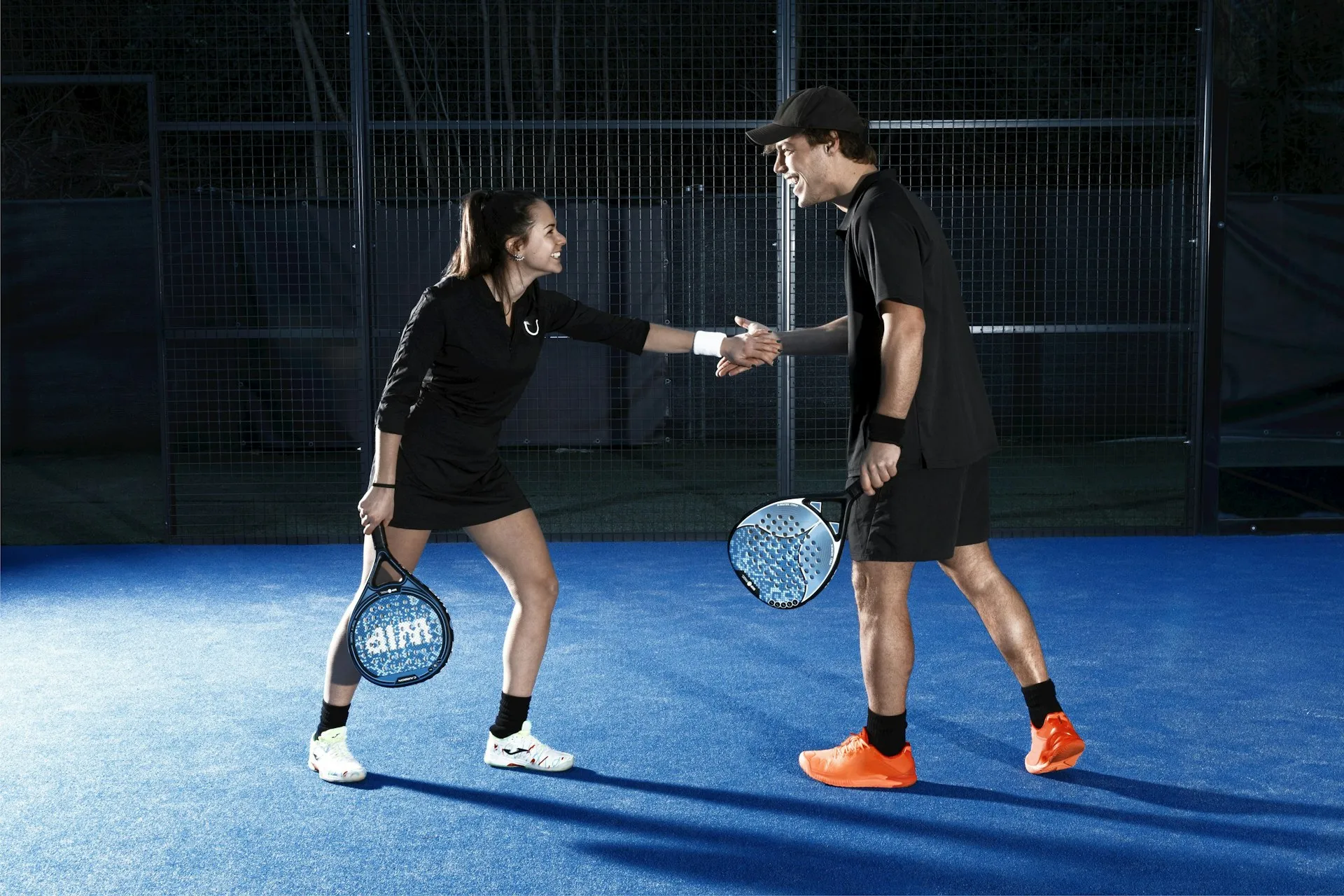
Handshake. At the end of the match, all four players approach the net and shake hands. This is a universal tradition inherited from tennis and obligatory in padel.
Say thank you. Thank your opponents for the game, regardless of the result. A simple “thanks for the match” or “good game” is the standard courtesy.
Score discussion. If you lost, do not make excuses. If you won, do not gloat. A brief exchange of impressions – “Great lob in the third set!” – is appropriate and welcome.
Clean up the court. Collect all the balls, pick up your water bottles and any rubbish. Leave the court in the condition you would want to find it.
The Social Culture of Padel
Padel is more than a sport. In many countries, especially Spain, Argentina, and Portugal, padel is an integral part of social life.
After a match, it is customary to spend time together: have a coffee or a beer at the club bar, discuss the game, and arrange the next session. This tradition is so deeply rooted that many clubs purposefully design lounge areas with a bar and terrace.
The padel court is a place where friendships and business connections are made. Many venues have messenger groups where players find partners and organise matches. Do not hesitate to join: openness to meeting new people is one of the core values of the padel community.
[EXPERT OPINION] It is precisely this social dimension that makes padel one of the fastest-growing sports in the world. People come for the sport and stay for the community.
“What level am I?” is one of the most frequent questions on padel forums. An objective assessment helps you find suitable partners, choose the right tournament, and understand what to work on.
Not sure where you stand? Take this 10-question quiz to get an approximate assessment of your level:
Find Your Padel Level
1 / 10
Why Know Your Level
Finding partners. Playing with players of your level is the fastest path to improvement. Opponents who are too strong demoralise you; those who are too weak offer no challenge.
Tournaments.Tournament formats require a stated level for category placement.
Training planning. Each level has its focus areas: at 2.0 there is no point working on the vibora, and at 5.0 there is no need to drill basic grip technique.
The 1.0–7.0 Scale
The most widely used system, based on the NTRP (National Tennis Rating Program) adapted for padel:
Tactical mastery: adapts strategy during the match
All shots at the highest level
Capable of competing at regional tournaments
Elite and Professional (6.0–7.0)
6.0–6.5 — Elite:
Regularly competes in national tournaments
All aspects of the game at the highest level
7.0 — Professional:
Competes in international tournaments (Premier Padel, FIP Tour)
Self-Assessment Checklist
Answer “yes” or “no” to each question. The first question you answer “no” to is approximately your current level:
Skill
Level
I can serve into the service box 7 out of 10 times
1.5+
I consistently keep the ball in play (forehand)
2.0+
I play the backhand with control
2.5+
I can volley at the net without panic
3.0+
I read rebounds off the back wall
3.5+
I use the lob as a tactical weapon
3.5+
I can execute a bandeja after a lob
4.0+
I control the pace of the rally
4.5+
I adapt tactics to the opponent
5.0+
I command the vibora, rulo, and other advanced shots
5.5+
Rating Platforms
Playtomic
The most popular court booking platform automatically calculates ratings:
Initial level determined by a registration questionnaire
Adjusted based on match results
Beating a higher-rated opponent raises your rating
NPRP (National Padel Rating Program)
A self-assessment system based on skill descriptions:
8 categories from Exploratory (1.0) to Professional (7.0)
Detailed skill descriptions for each level
Used in a number of clubs and leagues
[EXPERT OPINION] Do not fixate on numbers. A rating is a tool for finding suitable partners and tournaments, not a measure of your worth as a player. Play for enjoyment and progress will follow.
From Tennis to Padel: 10 Habits That Hold You Back
★ Beginner
4 min read
Last updated: 08.03.2026
Tennis experience is both a blessing and a curse when transitioning to padel. Reaction speed, coordination, and ball-reading help, but habits around swing length, power, and mentality work against you.
Padel looks similar to tennis: a racket, a net, a ball. But it is a different sport with a different philosophy. In tennis, the player who hits harder and more precisely wins. In padel, the pair that makes fewer errors and controls court position wins.
The problem: tennis habits have been reinforced over years. Your brain automatically launches familiar movements — long backswing, powerful shot, attempting to pass the opponent. In padel, all of this works against you.
10 Habits You Need to Change
1. Overpowering Every Shot
Problem: In tennis, a powerful shot wins the rally. In padel, a hard shot bounces off the glass and returns to your opponent at a comfortable height.
Solution: Aim for placement, not power. A soft shot at the opponent’s feet is more effective than a hard drive.
2. Ignoring the Walls
Problem: Tennis players try to hit the ball before it touches the wall. In padel, the wall is your friend: it gives you extra time.
Solution: If the ball is heading for the wall — let it bounce. Step back 1–2 metres and play after the rebound.
3. Tennis Grip
Problem: The eastern or semi-western grip limits versatility. It is awkward for volleys, the bandeja, and wall play.
Solution: Switch to the continental grip — the “hammer.” It covers 90% of situations in padel.
4. Long Backswing
Problem: On a 10×20 m court with four players, there is no time for a big swing. The ball will be past you before you finish your backswing.
Solution: Short, compact racket movements. The volley — the most frequent shot in padel — is executed with minimal backswing.
5. Attempting Passing Shots
Problem: In tennis, a passing shot wins the point. In padel, the court is small and the walls limit angles — passing shots are nearly impossible.
Solution: Use the lob to push opponents away from the net. The lob is not a weak shot — it is the primary tactical weapon in padel.
6. The “Domination” Mentality
Problem: In tennis, you hold the initiative until the end of the rally. In padel, both pairs switch between attack and defence multiple times in a single rally.
Solution: Patience. Work the rally, wait for the right ball to finish the point. Do not try to end every rally with one shot.
7. Two-Handed Backhand
Problem: In padel, space is limited; the ball often arrives close to your body and near the wall. A two-handed backhand is awkward in these conditions.
Solution: Develop a one-handed backhand with the continental grip. It is more compact and allows you to play in tight spaces.
8. Powerful Serve
Problem: In padel, the serve is hit underhand; the ball must bounce on the floor before being struck. An overhead tennis serve is not allowed under the rules.
Solution: Work on accuracy and placement of your serve. The padel serve starts the rally — it is not an ace weapon.
9. Standing Behind the Baseline
Problem: In tennis, the baseline is the default position. In padel, that is the defensive zone, not the attacking one. The pair controlling the net dominates.
Solution: Aim for the net position. Play from defence to attack: chiquita or lob → move to the net.
10. Playing as an Individual
Problem: Tennis singles is an individual sport. Padel is exclusively a doubles game. If you do not communicate with your partner, you lose.
Solution: Talk on court: “Mine!”, “Yours!”, “Switch!”. Move with your partner as if connected by an invisible rope.
What Tennis Skills Help
Not everything from tennis is useless. These skills accelerate your progress:
Ball reading — anticipating trajectory from the opponent’s swing
Footwork — lateral movement, split-step
Touch — controlling power and direction
Net reflexes — reactions for volleys
Competitive experience — performing under pressure
[EXPERT OPINION] A 5.0-rated tennis player can expect a starting level of 2.5–3.5 in padel. Tennis experience accelerates progress but does not replace padel-specific technique training.
Adaptation Plan
Weeks 1–2: Forget about power. Every shot — soft and controlled. Goal: keep the ball in play.
Weeks 3–4: Master the continental grip and a compact swing. Practise volleys.
Weeks 5–6: Wall work. Spend 15 minutes each session observing rebounds without hitting.
Weeks 7–8: Tactics. The lob as a weapon, the chiquita for net approaches, and partner communication.
Padel and pickleball are two of the fastest-growing racket sports in the world. While they share some surface similarities — both are played on smaller courts with solid-faced rackets — the actual gameplay, strategy, and culture are remarkably different.
Two Sports, One Boom
Both padel and pickleball have exploded in popularity in the 2020s. Padel dominates in Europe and Latin America with over 30 million players worldwide across 130+ countries, while pickleball has taken the United States by storm with nearly 20 million players. Despite occasional media framing as rivals, the two sports appeal to somewhat different audiences and can coexist comfortably.
Court Comparison
The most visible difference is the court itself.
Feature
Padel
Pickleball
Dimensions
20 × 10 m (66 × 33 ft)
13.4 × 6.1 m (44 × 20 ft)
Walls
Glass + metal mesh enclosure
None (open court)
Net height
88 cm centre, 92 cm sides
86 cm centre, 91 cm sides
Surface
Artificial grass, concrete, or synthetic
Hard court (concrete, asphalt)
Construction cost
€20,000–100,000
Can use existing tennis courts
The padel court’s glass walls and metal mesh are not decorative — they are integral to gameplay. Balls can be played off the walls after bouncing, creating unique angles and rallies that do not exist in pickleball.
Pickleball courts are much simpler to set up. A standard tennis court can be converted into two or more pickleball courts with minimal effort, which partly explains the sport’s rapid growth in the US where tennis infrastructure is widespread.
Equipment Differences
Feature
Padel
Pickleball
Racket
Solid, perforated (no strings), 360–380 g
Solid paddle, lighter, ~200–250 g
Ball
Similar to tennis ball, slightly less pressure
Plastic with holes (wiffle-style)
Shoes
Padel/clay court shoes (herringbone sole)
Court shoes (non-marking)
Padel rackets (also called “palas”) are thicker and heavier than pickleball paddles. They have no strings — power comes from the foam or EVA core and the fibreglass or carbon fibre faces. Pickleball paddles are thinner, lighter, and typically made from composite or graphite.
The balls differ dramatically. A padel ball looks like a tennis ball but with slightly lower pressure, producing a slightly lower bounce. A pickleball is a hollow plastic ball with holes, producing a distinctive low-bounce, slower-flight trajectory.
Rules and Scoring
Padel uses a tennis-based scoring system: 15-30-40-game, sets to 6, with Star Point at deuce (as of 2026 rules). Matches are typically best of 3 sets. Only doubles format is standard.
Pickleball uses rally scoring to 11 points (win by 2). In traditional rules, only the serving team can score. Both singles and doubles are played.
Serving also differs significantly:
In padel, the serve must bounce before being struck underhand, and it goes diagonally to the opposite service box
In pickleball, the serve is hit underhand diagonally, and the ball must clear the “kitchen” (no-volley zone)
Gameplay and Strategy
Padel gameplay revolves around the walls. Playing off the back wall and side walls is a fundamental skill. Rallies tend to be longer. The pair that controls the net position typically wins the point. Strategy involves patience, positioning, and using lobs, “bajadas” from the wall, and precise volleys.
Pickleball gameplay centres on the “kitchen” — a 2.1 m no-volley zone on each side of the net. Players can’t volley from inside this zone, creating a unique dynamic of “dinking” (soft exchanges near the net). The plastic ball limits power play, so placement and reflexes matter more than strength.
Physical intensity: Padel generally involves more running and longer rallies. Pickleball is often described as gentler on the body, though competitive play can be intense.
Popularity and Growth
Metric
Padel
Pickleball
Global players
~30 million
~20 million (mostly US)
Key markets
Spain, Argentina, Italy, Sweden, UAE
USA, Canada
Courts worldwide
77,000+
44,000+ (US alone)
Growth rate
10–15% annually
40%+ annually (US)
Market size (2024)
~$225M
~$1.5B
Padel is growing steadily across Europe, the Middle East, and increasingly in the US. Pickleball has experienced explosive growth in North America but has more limited global reach. Interestingly, about 30% of US pickleball facilities now also offer padel.
Demographics and Accessibility
Age appeal: Pickleball has historically attracted older players (the median age has been dropping to ~35), while padel’s core demographic is 26–50. Both sports are broadly accessible to all ages.
Gender balance: Both sports perform well with roughly 40% female participation globally.
Cost of entry:
Pickleball: paddle $30–150, many free public courts in the US
Padel: racket €60–300, court rental €15–50/hour (varies by country)
Learning curve: Both are considered easier to pick up than tennis. Pickleball’s smaller court and lighter ball make it slightly more immediately accessible. Padel requires learning wall play, which adds a layer of complexity but also depth.
Which Sport Should You Choose?
If you…
Try padel
Try pickleball
Love longer rallies and strategic depth
✓
Want something easy to pick up immediately
✓
Enjoy playing off walls (like squash)
✓
Prefer a lighter, less physical sport
✓
Live in Europe or Latin America
✓
Live in the US or Canada
✓
✓
Already play tennis
✓
✓
Want the most social doubles experience
✓
The honest answer: try both. They are different enough that enjoying one doesn’t prevent you from enjoying the other. Many players play both sports depending on who’s available and what courts are nearby.
Padel is a doubles sport — you always need at least one partner and ideally three more players. Finding regular playing partners is one of the first challenges new players face, but there are more options than ever before.
Why It Matters
With a 92% return rate after first-time play, padel is one of the stickiest sports out there. The challenge is not getting people hooked — it is connecting them. Whether you are brand new or have recently moved to a new city, these methods will help you find partners and build a regular playing group.
Digital Platforms
Playtomic
Playtomic is the largest padel platform globally with 4.7 million connected players across 6,000+ clubs in 66 countries.
How it works:
Download the app (iOS/Android) and create a profile
Set your skill level using the 0–7 scale
Browse Open Matches — public games created by other players, filtered by level and location
Join a match or create your own and wait for others to join
The algorithm adjusts your level after each match — wins against stronger opponents raise your ranking faster
Playtomic’s level system has become a de facto standard:
Level
Description
Below 1.5
Beginner — learning the basics
1.5–2.5
Initiation Intermediate — consistent rallies
2.5–3.5
Intermediate — good court positioning
3.5–4.5
Intermediate High — tactical awareness
4.5–5.5
Advanced — strong all-round game
5.5+
Competition / Professional
Padel Mates
A newer platform focused on community and smart matching. Features include personalised match suggestions based on skill level and preferred club, a map for discovering nearby facilities and players, and in-app chat. Padel Mates has partnered with Rocket Padel across all their UK and Denmark clubs (2025).
Other Apps and Platforms
Platform
Best for
Padelist.net
Web-based, no download needed; filter by skill and location
Playmate App
Partner-finding focused
MeetUp
General platform with active padel groups in many cities
PadelMix
Americano tournament generation and organisation
Social Media and Online Communities
Beyond dedicated apps, social media is a powerful tool for finding partners:
Facebook groups — search “[your city] padel” to find local groups. Active communities exist in most European cities with daily partner requests
WhatsApp groups — many clubs maintain groups for their regular players. Ask at reception or check the club’s website
Telegram — popular in some regions for player coordination
Instagram — follow local clubs for event announcements and open play sessions
Tip: When posting in any group, always state your approximate level (use the 1–7 scale) and preferred playing times. For example: “Level 2.0, looking for similar players for weekday evenings in central Madrid.”
At the Club
Open Play Sessions
Most padel clubs organise regular open play or social play sessions where you show up without a pre-arranged partner. The club organises groups, usually by level. This is one of the best ways to meet regular partners.
Group Lessons
Taking group coaching sessions is an effective way to meet players at your level. You will practise together, learn together, and naturally form playing partnerships.
Club Staff
Do not underestimate the staff at your local club. Coaches and reception staff know the regulars and can often introduce you to players of similar ability looking for partners.
Notice Boards
Physical and digital notice boards at clubs remain a simple way to advertise your availability. Include your level, preferred days and times, and contact details.
The Americano Format
Americano is the ultimate social padel format. If you want to meet new players, an Americano evening is the single best way to do it.
How It Works
Players needed: 8, 12, 16, or 20 (multiples of 4 work best)
Courts: 1 court per 4 players
Partners rotate every round — you play with and against everyone
Individual scoring: typically 24 or 32 points per round
Serving rotates every 4 points (no traditional games or sets)
Duration: 1.5–2 hours for a full event
Winner: the player with the highest total individual score
Americano Variations
Format
Key difference
Classic Americano
Individual scoring, rotating partners and opponents
Team Americano
Fixed partner for the entire event; team score
Mixed Americano (Mixto)
Each pair must be one male + one female
Why Americano Is Perfect for Finding Partners
You do not need a pre-formed pair — you can come alone. You play with every participant, so you naturally discover who you enjoy playing with. The rotating format is an equaliser: everyone gets the same number of matches. And it is typically followed by drinks or food, reinforcing the social atmosphere.
Many clubs run weekly Americano evenings. Check your local club’s schedule.
Mixed Doubles
Padel has one of the highest female participation rates in racket sports — roughly 40% of players globally are women. The sport’s emphasis on strategy over power creates naturally balanced mixed-gender matches.
Mixed play is a great way to expand your circle of potential partners. The smaller court and the importance of positioning over raw strength mean that mixed doubles can be competitive and enjoyable for everyone.
Etiquette When Playing with New Partners
When you play with someone for the first time, a few unwritten rules help everything go smoothly:
Be punctual and bring balls — arriving early and offering a fresh can of balls makes a good first impression
Call your own fouls honestly — padel is largely self-governed; honesty builds trust and repeat invitations
Support your partner — fist bumps, encouragement, and never criticising mistakes. Everyone makes errors
Keep the game flowing — retrieve balls quickly, minimal long breaks between points
Read the energy — in casual games, do not smash directly at weaker players. Match the intensity of the group
Communicating Your Level
Be honest about your ability. Using the widely recognised 1–7 scale helps set expectations:
1.0–2.5: Beginner — still learning basic shots and positioning
4.0–5.5: Advanced — strong technique, good tactical game
5.5–7.0: Elite / Professional
Understating your level leads to mismatched games where others feel outclassed. Overstating it leads to frustration for everyone. Honesty produces the best matches.
Club Social Events
Beyond regular play, clubs typically offer a range of social events:
Event type
Description
Open Play
Drop-in sessions, no partner needed
Americano Nights
Weekly rotating-partner tournaments
Beginner Clinics
Introductory group lessons (60–90 min)
League Nights
Regular competitive play by level
Women’s Sessions
Dedicated sessions for female players
Open Days
Free introductory sessions for newcomers
Clubs with integrated social spaces (bar, lounge area) report significantly higher member retention. The social side of padel is not a bonus — it is core to the sport’s appeal.
Getting Started
Download Playtomic (or the dominant app in your area) and set your level honestly
Join an Open Match at a nearby club — the simplest first step
Attend an Americano evening — the best way to meet many players at once
Take a group lesson — meet partners while improving
Join local Facebook/WhatsApp groups — stay connected between sessions
Be consistent — showing up regularly is the fastest way to build a playing circle
The padel community is welcoming by nature. The hardest step is the first one — after that, the sport does the rest.