Padel vs Tennis: What's the Difference
Padel and tennis are related racket sports, but there are fundamental differences between them: from court dimensions and racket type to serving rules and game format. Understanding these differences will help tennis players adapt to padel more quickly, and newcomers choose the right sport.
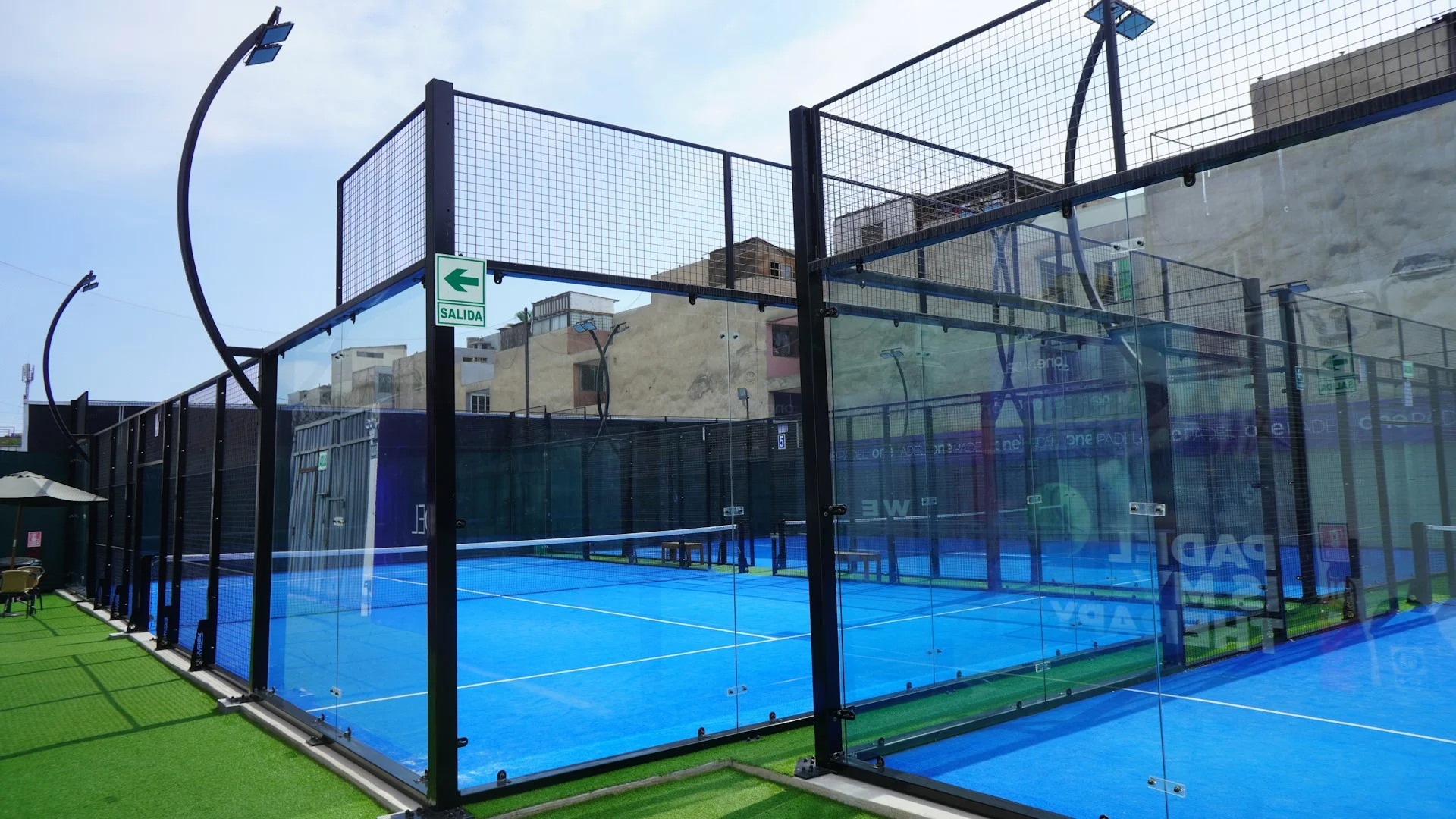
Photo: Bruno Vaccaro Vercellino / Unsplash
Photo: Bruno Vaccaro Vercellino / Unsplash / Unsplash LicenseQuick Comparison Table
| Parameter | Padel | Tennis |
|---|---|---|
| Court | 10 x 20 m, enclosed by walls | 23.77 x 10.97 m (doubles), open |
| Walls | Yes, ball can be played off walls | No |
| Racket | Solid, no strings, perforated | Strung, oval head |
| Ball | Slightly lower pressure | Standard pressure |
| Serve | Underhand, below waist level | Overhead |
| Scoring | 15, 30, 40 (often golden point) | 15, 30, 40 (classic deuce/advantage) |
| Format | Doubles only (2 vs 2) | Singles and doubles |
| Physical demands | Less running, more tactical | More running and athleticism |
| Learning curve | Low, easy to start | Medium, requires technique |
Court: Enclosed vs Open
One of the most visible differences is the court itself. A padel court is significantly more compact than a tennis court: it measures 10 x 20 meters, while a doubles tennis court is 23.77 x 10.97 meters. The tennis court area is roughly one and a half times larger.
The defining feature of a padel court is its walls. The court is enclosed on all sides: back walls (usually made of glass or concrete, 3-4 meters high) and side walls with metal mesh. A ball that bounces off a wall remains in play — this is a fundamental part of padel rules, entirely absent in tennis. For more details on court specifications, see court dimensions and markings.
Racket: Solid vs Strung
Tennis uses a racket with a strung hitting surface and a long handle (total length up to 73.7 cm). The strings create a trampoline effect and allow players to generate significant spin.
The padel racket is fundamentally different: it is a solid construction made from composite materials (carbon fiber, fiberglass) with a foam core (EVA or FOAM). Instead of strings, the hitting surface has perforations (holes). A padel racket is up to 45.5 cm long and typically weighs 340-380 grams. An unstrung tennis racket weighs 260-340 grams. For a more detailed guide on racket selection, read how to choose a racket.
Ball: Almost Identical, but Not Quite
At first glance, padel and tennis balls are virtually indistinguishable. They are the same size and color. However, a padel ball has slightly lower internal pressure (4.6-5.2 kg/cm² versus 5.6-6.3 kg/cm² for a tennis ball). This means the padel ball bounces slightly lower, making the game more controlled on a compact court with walls.
In practice, many recreational players use tennis balls for padel, but at the professional level the pressure difference plays a significant role.
Serve: Underhand vs Overhead
In tennis, the serve is one of the most powerful shots. The player tosses the ball and strikes it overhead, with professional serve speeds reaching 200-250 km/h. The serve in tennis is often a decisive weapon.
In padel, it is the opposite: the serve must be performed underhand. The ball must bounce on the ground first, and the strike must occur below waist level. This makes the serve a far less aggressive element of the game. In padel, the serve functions more as a way to start the rally rather than a means of scoring directly. For more on serving rules, see serving rules.
Scoring: Similar, but with Nuances
The basic scoring system in padel and tennis is identical: 15, 30, 40, game. A set is played to 6 games with a tiebreak at 6-6. A match is typically played as best of three sets.
The key difference is the golden point (punto de oro). At many padel tournaments, when the score reaches deuce, a single decisive point is played instead of the classic advantage system. The receiving pair chooses which side to receive from. The golden point speeds up play and adds drama.
Game Format: Doubles Only
Tennis offers both singles and doubles formats. Padel is played exclusively in doubles — 2 vs 2. This is one of the sport’s defining characteristics. Singles padel exists as an unofficial format, but standard courts and rules are designed for four players.
The doubles format shapes the tactics: coordination with your partner, positional play, and on-court communication are critically important skills. Learn more about the fundamentals in our article what is padel.
Walls: Padel’s Unique Element
The use of walls is what makes padel a truly unique sport. After bouncing off the floor, the ball may hit the back or side wall, and the player is allowed to play it after such a bounce. Moreover, in certain situations a player can hit the ball out of the court over the side wall and return it from outside (the so-called “salida de pared” or “going outside the court”).
This mechanic adds an extra dimension of tactics. Shots that would be winners in tennis can be “saved” off the wall in padel. This makes rallies longer and more spectacular.
Physical Demands
Tennis is an extremely athletic sport. The large court requires intensive movement: sprints, sharp changes of direction, and long lunges toward the ball. Professional tennis matches can last several hours and demand outstanding endurance.
Padel, thanks to its compact court, requires less running. However, this does not mean padel is less intense. The emphasis shifts to quick reactions, reflexes, shot precision, and tactical thinking. The physical load in padel is more evenly distributed and puts less stress on joints, making the sport accessible to a wide age range.
Learning Curve
[EXPERT OPINION] Padel is considered one of the most accessible racket sports for beginners. The compact court, underhand serve, solid racket, and walls that “help” keep the ball in play — all of this allows newcomers to enjoy the game from the very first minutes.
In tennis, the learning curve is considerably steeper. Comfortable play requires mastering basic stroke technique, learning to control a strung racket, and developing sufficient fitness to move around a large court. This typically takes months of regular practice.
If you are just starting out, check out our guide on how to start playing padel.
Social Aspect
The doubles format makes padel inherently more social. There are always four people on court, creating a relaxed and friendly atmosphere. Many padel clubs organize the “americano” format — tournaments with rotating partners, which encourages meeting new people and expanding your social circle.
Tennis, especially in singles, is a more individual sport. Although doubles tennis exists, padel culture is built from the ground up around playing together and socializing.
Who Is Padel Right For
Padel is especially suitable for:
- Former tennis players — basic racket sport skills transfer easily
- Beginners — low barrier to entry, quick progress
- Older adults — less stress on joints
- Those seeking a social sport — doubles format and club culture
- Busy people — a match takes 60-90 minutes
The light is on for free. But someone has to clean the lantern.
☕ Support on Ko-fi