Court Zones Glossary
A padel court is more than a rectangle. Each zone has tactical significance and specific names used by coaches and commentators. This reference will help you navigate the geography of the court.
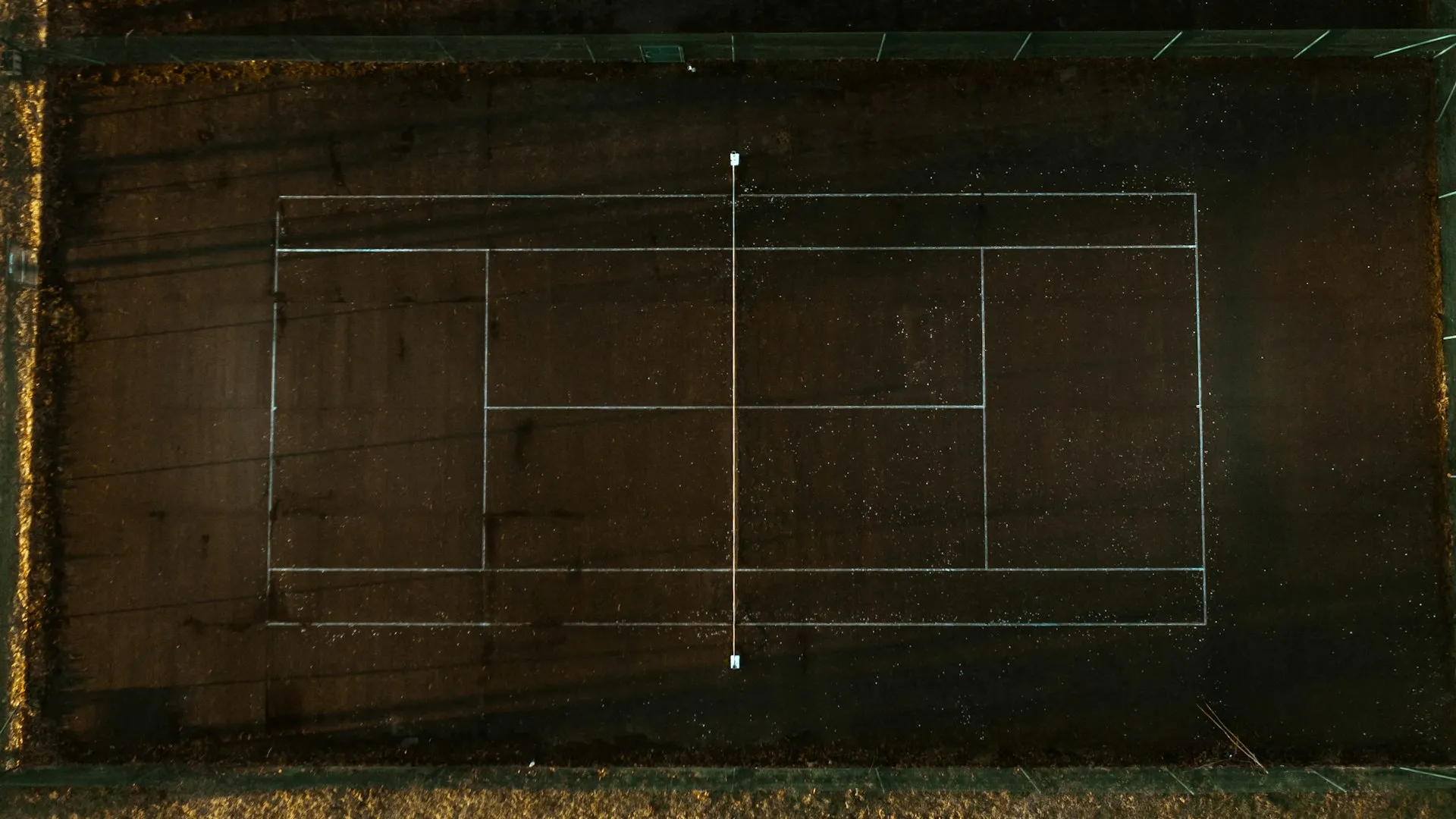
Photo: Raphael Peillon / Unsplash / Unsplash License
Court Overview
A padel court measures 20 × 10 metres and is divided by a net into two halves. Each half is split by the service line into a front zone and a back zone.
Click a zone to learn more
Main Zones
Front Zone (La Red / La Zona de Red)
The area from the net to the service line (~3 metres from the net).
- Tactical significance: the dominant position. The pair controlling the net controls the rally.
- Typical shots: volley, bandeja, víbora, smash
- When to occupy: after a successful attack, a quality return of serve, or an opponent’s lob
Back Zone (El Fondo / La Zona de Fondo)
The area from the service line to the back wall (~7 metres deep).
- Tactical significance: a defensive position. The goal is to work your way back to the net.
- Typical shots: globo / lob, bajada, wall shots
- When you end up here: after an opponent’s lob, when you lose your net position
Middle Zone (La Zona Media / Tierra de Nadie)
The space around the service line (~1–2 m either side).
- Tactical significance: “no-man’s land” (tierra de nadie). The most vulnerable position on court.
- Why it is dangerous: the ball arrives at your feet — too low for a comfortable volley, too high for a clean groundstroke
- [EXPERT OPINION] Move through this zone quickly — either advance to the net or retreat to the back wall. Do not linger in no-man’s land.
Left and Right Sides
Right Side (Lado Derecho / Drive Side)
- The side where the player hits forehands (for right-handers)
- The default position for the right-side player in a pair
- [EXPERT OPINION] The right side is typically played by the more consistent, defensive player
Left Side (Lado Izquierdo / Revés Side)
- The side where backhands are more frequent
- The default position for the left-side player in a pair
- [EXPERT OPINION] The left side is considered the attacking side: it is easier to finish rallies with a smash through the centre from here
Centre Line (Línea Central)
Divides the right and left service boxes. Important during the serve — the ball must land in the diagonally opposite box.
Wall Zones
Back Wall (Pared de Fondo)
- Height: 3 m glass + 1 m mesh
- A ball bouncing off the back wall remains in play
- The defining feature of padel that sets it apart from tennis
Side Walls (Paredes Laterales)
- Stepped construction: glass near the back wall, metal mesh nearer the net
- A ball can bounce off the side wall and remain in play
- The junction of glass and mesh is a “dead zone” where the ball loses energy
Corner (La Esquina)
The junction of the back wall and a side wall.
- Balls hitting the corner bounce unpredictably
- One of the hardest zones to defend
- Attacking shots into the corner are an effective tactic
Service Zones
Service Box (Cuadro de Saque)
Each half of the court is divided by the service line and centre line into two boxes:
- Right box (deuce side): serves begin each game here
- Left box (advantage side): serves when the total points are odd
The server stands behind the service line and directs the ball into the opponent’s diagonally opposite box.
Tactical Zones
The “T” (La T)
The intersection of the service line and the centre line. Named after the “T” shape it forms.
- Significance: the optimal net position, allowing coverage of both corners
- A net pair aims to position themselves on either side of the T
The Corridor (El Pasillo)
The narrow space along the side wall.
- A shot “down the corridor” (por el pasillo) is a powerful straight shot along the side wall
- One of the main finishing shots in padel
Centre of the Court (El Centro)
The space between the two players of a pair.
- A shot “through the centre” — between the two opponents — causes confusion
- [EXPERT OPINION] A shot through the centre is often more effective than a shot down the line because it forces opponents to decide who plays the ball
FAQ
What does “coming to the net” mean? Moving from the back zone to the front zone after a quality shot. The aim is to take the dominant position.
Why is “no-man’s land” dangerous? At the service line, the ball arrives at knee height — too low for a comfortable volley and too high for a clean groundstroke.
All our knowledge is free. Creating it is not.
☕ Support on Ko-fi