Padel Terms A-Z Glossary
A comprehensive A-to-Z glossary of padel terminology. This reference covers key concepts from rules, technique, tactics, and equipment, including the original Spanish terms used on courts worldwide. Suitable both for newcomers learning the sport and experienced players looking to consolidate their knowledge.
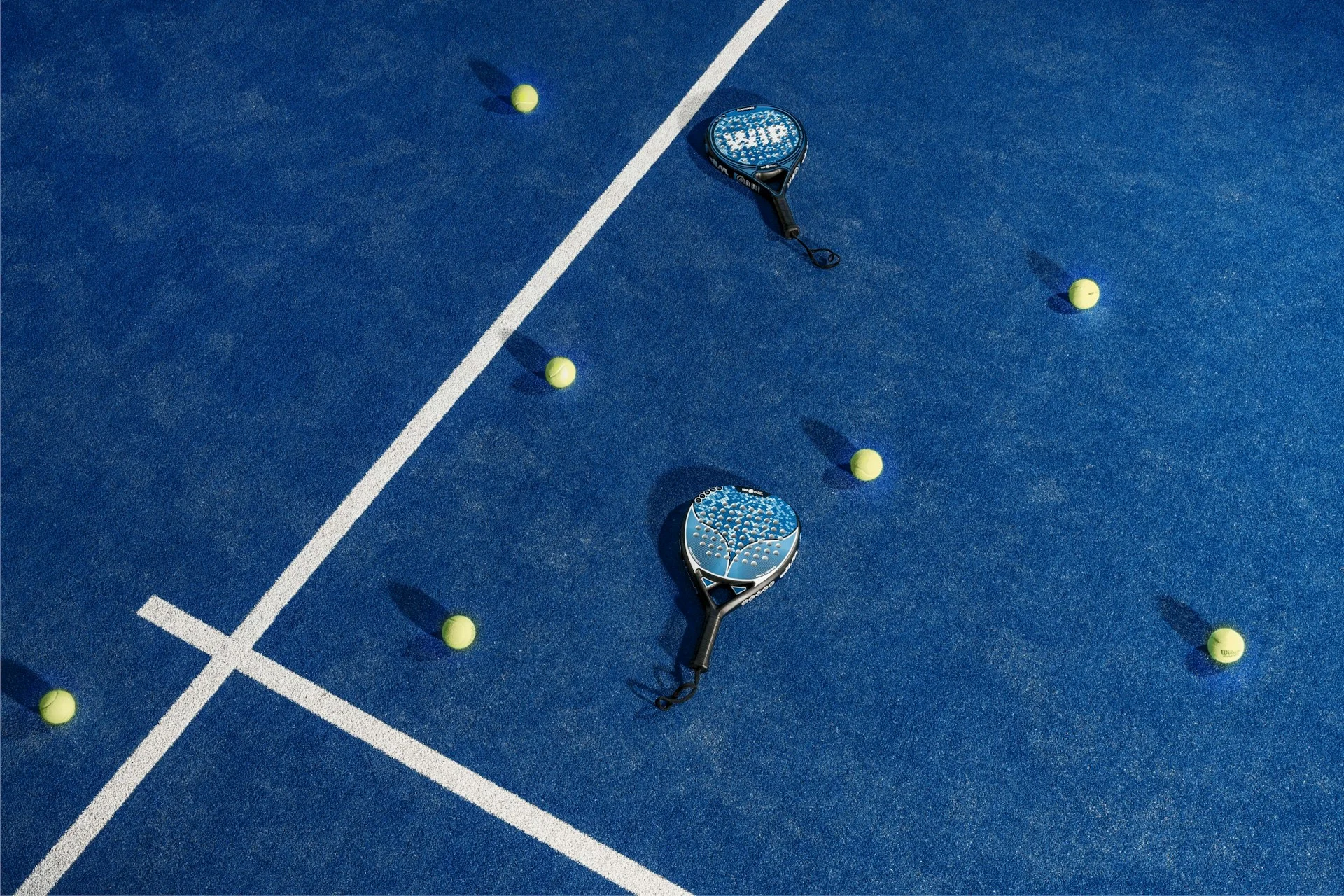
Photo: Vincenzo Morelli / Unsplash
Photo: Vincenzo Morelli / Unsplash / Unsplash LicenseHow to Use This Glossary
Terms are arranged in Latin alphabetical order. Many entries include the original Spanish term in parentheses, since padel originated in Spanish-speaking countries and Spanish terminology is universally used on courts around the world. Each definition briefly explains the concept, and cross-links help you explore specific topics in greater depth.
A
Advantage (ventaja) — a scoring state within a game when one pair has won a point after deuce. Winning the next point secures the game; losing it returns the score to deuce. For more on scoring, see the official padel rules.
ATP shot (around the post) — a spectacular shot in which the ball travels around the outside of the net post. It is executed when the ball bounces off the wall and exits the court through the side opening. The term is borrowed from pickleball, where around-the-post shots are also a notable part of the game. One of the most visually impressive shots in padel, requiring precise trajectory calculation.
B
Bajada — an attacking shot played against a ball that has bounced off the back wall. Executed with a downward motion, its purpose is to seize the initiative and advance toward the net. A critical element for transitioning from a defensive position to an offensive one.
Bandeja — a half-smash performed at head or eye level with backspin. The name comes from the Spanish word for “tray,” reflecting the flat, tray-like motion of the racket during the stroke. Unlike a full smash, the bandeja is a controlled shot that allows the player to maintain their position at the net without sacrificing accuracy. One of the key shots at intermediate and advanced levels.
Bote pronto — a shot struck immediately after the ball bounces off the floor, virtually at the moment of contact with the surface. This technique demands excellent timing and allows players to accelerate the pace of a rally, giving opponents less time to prepare.
C
Chiquita — a short, soft shot aimed low over the net at the feet of opponents standing at the net. The primary goal is to force the opponents to play the ball from below, creating an opportunity to move into an attacking position. A key tactical element from the technique arsenal.
Continental grip — a universal racket grip in which the palm is placed on the top edge of the handle (as if shaking hands). In padel, this is considered the foundational grip suitable for most shots: volleys, serves, bandejas, and viboras.
Contrapared — a shot in which the ball is directed into the back wall on one’s own side of the court so that it crosses over to the opponent’s side on an unexpected trajectory. A sophisticated tactical maneuver used in defensive situations.
Corner (esquina) — the area of the court where the back wall meets the side wall. Shots aimed at the corner create difficult bounces that are hard to read and return. Deliberate targeting of corners is an important tactical element.
D
Deuce (iguales) — a tied score of 40-40 within a game. After deuce, a pair must win two consecutive points (advantage, then game) to win the game. In some tournaments, the golden point rule is used instead.
Double bounce — a situation in which the ball bounces twice on the floor on one side of the court. This results in the loss of the point for the pair on whose side the double bounce occurred. Wall bounces do not count — the ball may bounce off the walls any number of times between floor contacts.
Drive — a flat or slightly spun forehand or backhand shot played after the ball bounces. A fundamental attacking stroke, similar to its tennis equivalent but typically executed with less aggression in padel due to the compact court.
E
Eastern grip — a racket grip in which the palm is placed on the side of the handle. Used less frequently than the continental grip in padel but may be employed for forehand shots when additional control is needed on flat strokes.
F
Flat (shot) — a shot struck without spin. The ball travels on a straighter trajectory at higher speed but behaves less predictably when bouncing off walls. Used for powerful finishing shots.
Foot fault — a serving violation that occurs when the server steps on or beyond the baseline before making contact with the ball. The serve is counted as a fault. For details, see the serving rules.
FIP (Federación Internacional de Pádel) — the International Padel Federation, the principal governing body of world padel. Founded in 1991, it unites national federations, regulates official rules, and organizes world championships. Learn more in What is Padel.
G
Game (juego) — the basic scoring unit in padel. Points within a game are counted as 0 (love), 15, 30, 40. To win a game, a pair must score four points with a margin of at least two (or win the golden point at deuce, if the applicable rules are in effect).
Golden point (punto de oro) — a deciding-point format played at deuce, in which the next point wins the game. The receiving pair chooses which side the serve is directed to. The golden point rule is used in many professional tournaments to speed up match play.
Globo — see Lob.
H
Half-volley — a shot played immediately after the ball bounces off the floor, when the ball is at its lowest point. A technically demanding stroke, often used in the transition zone between the back of the court and the net.
K
Kick (effect) — a type of spin that causes the ball to bounce higher than normal and deviate to the side after landing. Kick spin is applied in serves and smashes to create awkward bounces off the walls and floor.
L
Let — a service replay awarded when the ball clips the top of the net cord and lands in the correct service box. The serve is replayed without penalty. A let is also called when there is an obstruction on the court.
Lob (globo) — a high, arcing shot directed over the heads of opponents positioned at the net. One of the most important tactical tools in padel — the lob forces opponents to retreat toward the back wall, surrendering control of the net.
Love — zero in the tennis (and padel) scoring system. The term is thought to derive from the French “l’oeuf” (egg — resembling a zero in shape).
M
Malla / Rejilla (metallic mesh/fence) — a structural element of the court enclosure, located in the upper portion of the side walls and above the back walls. A ball that strikes the metallic mesh behaves differently from one that hits the glass: it loses more energy and rebounds less predictably.
Match point — a situation in which one pair is a single point away from winning the match.
N
Net (red) — the barrier dividing the court into two equal halves. The net stands 88 cm high at the center and up to 92 cm at the side posts. Touching the net with the racket or body during a rally results in the loss of the point.
O
Out (fuera) — a ball that has left the playing area. In padel, a ball is considered “out” if it exits the court over the top of the walls or through the side openings without first bouncing on the opponent’s floor.
Overhead — a general term for any shot executed above the head: smash, bandeja, vibora. Dominance in the overhead game is one of the keys to controlling the net.
P
Pala (racket) — the padel racket. Unlike a tennis racket, it has no strings — it is a solid structure made from composite materials (carbon fiber, fiberglass, EVA foam) with a perforated surface. For more details, see the equipment section.
Par — a designation for court type: indoor or outdoor. Indoor courts are shielded from wind and rain, providing more consistent playing conditions.
Punto de oro — see Golden point.
R
Rally — a continuous exchange of shots between the two pairs from the moment of the serve until the point ends. Rallies in padel are typically longer than in tennis, thanks to the walls and the defensive possibilities they create.
Remate — see Smash.
Return (resto) — the shot played to receive the serve. In padel, the ball must bounce on the floor before the returner strikes it. A quality return is the foundation for seizing the initiative in a rally.
S
Saque — see Serve.
Serve (saque) — the shot that begins every point. In padel, the serve must be struck underhand: the ball is bounced and hit at or below waist level. The serve must be directed diagonally into the opponent’s service box. For details, see the rules.
Set — a segment of a match composed of games. To win a set, a pair must win 6 games with a lead of at least 2. At 6-6, a tiebreak is played. A standard match is played as best of three sets.
Side spin — spin applied around the ball’s vertical axis, causing it to curve sideways after bouncing. Especially effective on shots that subsequently hit a wall, producing unpredictable trajectories.
Slice — a shot struck with backspin (underspin). The ball travels on a flatter trajectory, bounces low, and decelerates after hitting a wall. Slice is the primary spin type for the bandeja and many defensive shots.
Smash (remate) — a powerful finishing overhead shot aimed at winning the point outright or forcing a weak reply. In padel, the smash is frequently directed at the back wall or glass to generate a difficult bounce.
Sweet spot — the central area of the racket’s hitting surface that delivers maximum power and control on contact.
T
Tiebreak — a shortened game played at 6-6 in a set. Scoring is by individual points (1, 2, 3…), and the first pair to reach 7 points with a margin of 2 wins the tiebreak and the set.
Topspin — forward rotation of the ball that causes it to dip faster and bounce higher. In padel, topspin is used less frequently than in tennis because of the walls: a high bounce off the back wall gives opponents additional time to react.
Tray — see Bandeja.
V
Vibora (víbora) — an attacking overhead shot with side spin and a lower trajectory. Unlike the bandeja, the vibora is more aggressive and is executed with pronounced side spin, creating a difficult bounce off the side wall.
Volea (volley) — a shot struck before the ball touches the floor. The volley is the primary stroke for a pair controlling the net position. There are forehand volleys (volea de derecha) and backhand volleys (volea de revés).
W
WPT (World Padel Tour) — one of the largest professional padel tournament series, running since 2013. Together with Premier Padel, it forms the elite tier of world professional padel.
Wall play (juego de paredes) — the use of walls during play, the fundamental element that distinguishes padel from other racket sports. The ball may bounce off the back and side walls after touching the floor and still remain in play. The ability to read wall bounces is a crucial skill for players at every level. Learn more about court construction.
All our knowledge is free. Creating it is not.
☕ Support on Ko-fi