Evolution of Padel Equipment
From wooden paddles of the 1970s to carbon-fibre rackets with aerodynamic designs — padel equipment has undergone a transformation comparable to tennis rackets. Technology has made the game faster, more powerful, and more accessible.
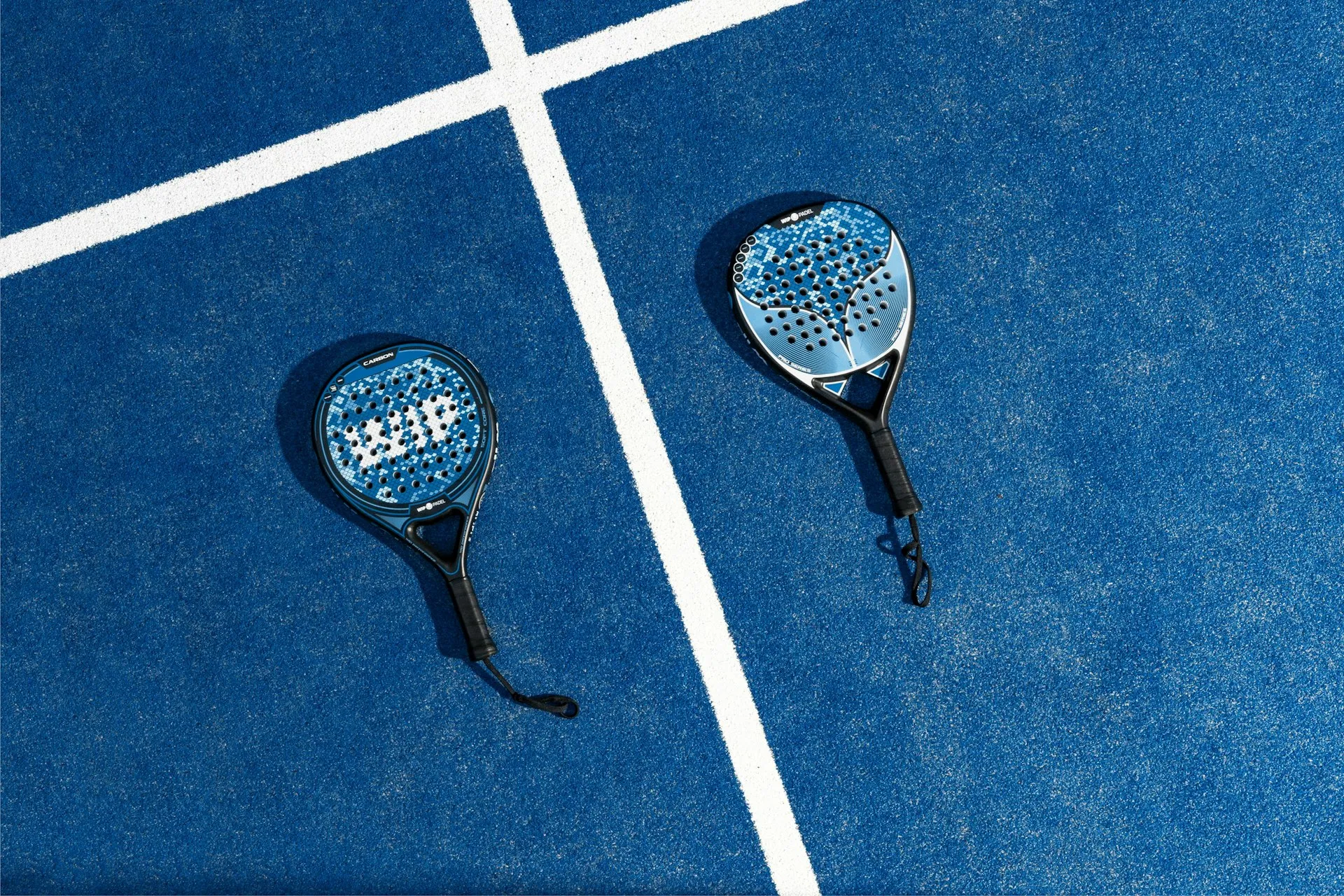
Photo: Vincenzo Morelli / Unsplash / Unsplash License
Racket Evolution
1970s: Wooden Paddles
Corcuera’s first court was played with the simplest of tools — a solid wooden paddle without perforations.
- Material: solid wood
- Weight: 400–450 g
- Perforations: none
- Characteristics: heavy, minimal control
1980s: Fibreglass and Perforations
The first fibreglass rackets appeared. The key innovation was perforation (holes in the face), reducing air resistance.
- Material: fibreglass, basic polymers
- Weight: 370–420 g
- Core: dense foam
- Progress: lighter and more manoeuvrable
1990s: Carbon Fibre and EVA
A materials revolution. Carbon fibre appeared in rackets, providing strength at lower weight. EVA foam cores offered better shock absorption.
- Face material: carbon fibre, fibreglass
- Core: EVA (firm, more control), FOAM (soft, more power)
- Weight: 360–390 g
- Progress: variety of racket shapes — round, teardrop, diamond
2000s: Shape Specialisation
Manufacturers began producing rackets for different playing styles:
| Shape | Purpose | Target audience |
|---|---|---|
| Round | Control, balance | Beginners and all-rounders |
| Teardrop | Power/control balance | Versatile players |
| Diamond | Maximum power | Advanced, attacking players |
See Racket Shapes and How to Choose a Racket for details.
2010s–2020s: High Technology
The modern era is defined by technological innovation:
- Textured surfaces: rough carbon for increased spin
- Multi-layer construction: combinations of 3K, 12K, and 18K carbon of different densities
- Aerodynamic profiles: reduced air resistance during the swing
- Vibration dampeners: built-in systems to reduce vibration, protecting against tennis elbow
- Hybrid cores: different foam densities in the centre and edges of the face
Ball Evolution
Early Period
Standard tennis balls were used initially. They proved too fast and bouncy for the enclosed court.
Modern Balls
Padel balls look similar to tennis balls but differ in key ways:
| Parameter | Tennis ball | Padel ball |
|---|---|---|
| Pressure | 56–60 g/cm² | 47–52 g/cm² |
| Bounce (from 2.54 m) | 135–147 cm | 135–145 cm |
| Weight | 56–59.4 g | 56–59.4 g |
| Diameter | 6.54–6.86 cm | 6.35–6.77 cm |
Key difference: lower pressure produces a slower bounce, which is critical for wall play.
Ball standards are governed by the FIP rules.
Shoe Evolution
From Tennis Shoes to Padel-Specific Footwear
In the 1990s–2000s players wore tennis shoes. By the 2010s brands began producing dedicated padel shoes.
Key features of padel shoes:
- Outsole: herringbone pattern optimised for lateral movement on artificial grass
- Lateral support: reinforced, to protect the ankle during sharp direction changes
- Cushioning: emphasis on the heel and forefoot
- Weight: lightweight construction (300–380 g)
Court Evolution
Equipment includes not just what the player holds, but the court itself.
Walls
- 1969: concrete walls (Corcuera’s original court)
- 1974: first glass panels (Hohenlohe-Langenburg, Marbella)
- Today: 10–12 mm tempered glass + galvanised metal mesh
Surface
- Early period: concrete, asphalt
- 2000s: artificial grass with silica sand became the standard
- Today: specialised surface types with controlled speed and bounce
Lighting
- Early period: standard floodlights (halogen)
- Today: LED systems with uniform illumination of 500–1000 lux
What’s Next?
[EXPERT OPINION] Equipment development trends:
- Smart rackets — built-in sensors for shot analysis (speed, spin, contact point)
- Sustainable materials — recycled polymers, biocomposites
- Personalisation — 3D-printed racket components tailored to individual player characteristics
- Next-generation surfaces — synthetic surfaces that do not require sand infill
If this article was useful — help us write the next one.
☕ Support on Ko-fi