Official Padel Rules (FIP)
In brief: Padel is a doubles racket sport played on an enclosed court measuring 10 by 20 meters with glass and metal mesh walls. The rules are governed by the International Padel Federation (FIP) and cover court specifications, ball and racket requirements, service, rally play, and scoring. This article provides a structured overview of all the main sections of the official regulations.
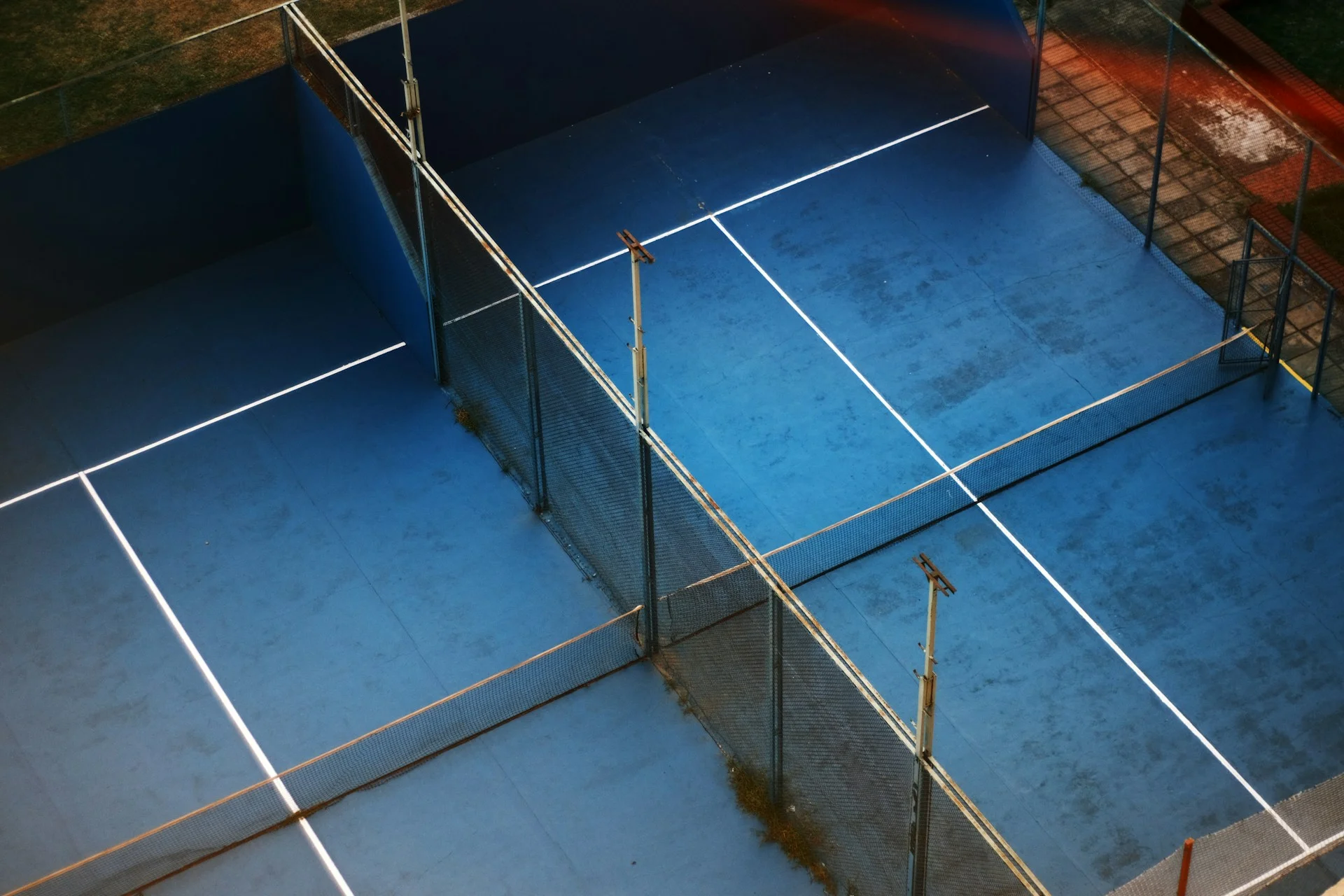
Photo: José Alejandro Cuffia / Unsplash
Photo: José Alejandro Cuffia / Unsplash / Unsplash LicenseThe Court
A padel court is a rectangle 10 m wide and 20 m long, divided by a net at the center. The net height is 88 cm at the center and 92 cm at the posts. The court is enclosed by walls: back walls are 4 meters high (the lower 3 meters made of glass, the upper meter of metal mesh), and side walls vary in height. The floor surface may be artificial grass, concrete, or another approved material.
On either side of the net, service boxes are formed by the center service line and the service line located 6.95 m from the net. All court lines are 5 cm wide.
For more details on dimensions and markings, see Court Dimensions and Markings.
The Ball
FIP regulates the exact specifications of the ball for official competition:
- Diameter: 6.35 to 6.77 cm
- Weight: 56 to 59.4 g
- Bounce height: 135 to 145 cm when dropped from a height of 2.54 m onto a hard surface
- Pressure: 4.6 to 5.2 kg/cm² at sea level
Since 2026, the ball is no longer restricted to yellow or white — any color is acceptable provided it contrasts with the court surface. Only FIP-approved balls may be used at official tournaments. Balls are replaced at the referee’s discretion or per tournament regulations — typically after a set number of games.
The Racket
A padel racket differs significantly from a tennis racket. Key FIP requirements:
- Maximum length: 45.5 cm (including the handle)
- Maximum width: 26 cm
- Maximum thickness: 38 mm
- Hitting surface: perforated (holes 9–13 mm in diameter), no strings
- Wrist strap: mandatory during play
The racket may be made from various materials — carbon fiber, fiberglass, EVA foam, or other composites. Playing without a wrist strap is a rule violation and may result in a warning.
Players
Padel is exclusively a doubles sport. There are always four players on court — two per team. Singles padel is not part of official FIP competition.
Before the match, each team determines the serving order and the players’ positions on the right and left sides of the court. The serving order is maintained throughout the set but may be changed at the start of a new set. Switching sides (right/left position) is only permitted between sets, provided the team notifies the umpire in advance.
For more on what padel is and how it works, see What Is Padel?.
The Serve
The serve is executed from behind the service line diagonally into the opponent’s service box. Key rules:
- The ball must bounce on the floor before the server strikes it
- The strike must be made at waist level or below
- Both of the server’s feet must remain behind the service line (and its imaginary extension toward the side walls)
- The ball must land in the correct service box and bounce on the floor before touching any wall
- Each point begins from the right-hand side (from the server’s perspective)
- Two attempts are allowed — if the first serve is a fault, the server may serve again
If the ball clips the net on a serve but lands in the correct service box, a let is called and the serve is replayed.
For a complete breakdown of serving rules, see Serving Rules.
Rally Play
After the serve, the ball is in play until a point is won or a let is called. Core principles:
- The ball must cross the net and bounce on the opponent’s floor at most once before being returned
- After bouncing on the floor, the ball may touch the walls, and players can return it after a wall bounce
- The ball may only be struck with the racket; any contact with the body results in loss of point
- The ball may leave the court over the top of the wall or through an open section of the enclosure; in this case, a player may run outside the court to retrieve and return the ball, provided it has not bounced on the ground twice
The use of walls is one of the defining tactical features of padel. For more details, see Wall Play Rules.
Scoring
The scoring system in padel is identical to tennis:
- Points in a game: 0 (love) — 15 — 30 — 40 — game
- At 40-all — deuce; a two-point advantage is required to win the game
- A set is won by the first team to reach 6 games with a margin of at least 2
- At 6-6 — a tiebreak to 7 points (with a 2-point margin)
- A match is played as best of 3 sets
Since 2026, professional tournaments use the Star Point system: at 40-all, up to two advantage cycles are played. If the game remains undecided, a single Star Point rally determines the winner. This replaced the earlier “golden point” (immediate sudden death at deuce). See Rule Changes 2026 for details.
For a detailed breakdown of the scoring system, see Scoring System.
Loss of Point
A team loses the point in the following situations:
- The ball bounces twice on the floor on their side of the court
- The ball hits a player — if the ball strikes any part of a player’s body before bouncing on the floor
- The ball strikes the player’s own side — if after being hit, the ball first contacts the floor, wall, or net on the hitter’s side rather than crossing the net
- Touching the net — if a player, their racket, or clothing touches the net or net posts during a rally
- Volleying before the ball crosses the net — if a player strikes the ball before it has fully crossed to their side
- Double hit — if the ball strikes the racket twice
- Service fault — double fault (two consecutive serve faults)
- The ball hits the metal mesh fence on the hitter’s side before crossing the net
Walls and Bounces
Walls are an integral part of the playing area in padel. Key rules:
- The ball remains in play after bouncing on the floor and then touching the back or side wall
- A player may return the ball after any number of wall contacts, provided the ball has bounced on the floor only once
- If the ball exits the court over the top of the wall after being struck — play continues as long as the ball has not bounced on the outside surface twice
- A ball that hits the opponent’s wall directly (without first bouncing on the floor) means loss of point for the striking team
For more on wall play specifics, see Wall Play Rules.
Code of Conduct
FIP sets standards for sportsmanlike behavior from all participants:
- Sportsmanship: verbal abuse, obscene language, deliberate damage to equipment, and aggressive behavior are grounds for a warning, penalty point, or disqualification
- Time-outs and breaks: a break between sets is permitted (up to 120 seconds), and changeovers occur every two odd games (up to 90 seconds); exceeding the time limit results in a warning
- Warm-up: reduced from 5 minutes to 3 minutes (from 2026)
- Eating and drinking: prohibited between points (only allowed during changeovers, from 2026)
- Coaching: at most tournaments, on-court coaching during a match is prohibited, except in specifically designated formats
- Medical time-out: one medical break per match is allowed, lasting up to 3 minutes
- Safety cord: if the racket’s safety cord breaks or the racket leaves the player’s hand during a rally, the pair immediately loses the point (from 2026)
Rule Updates
Please Note
The rules of padel are maintained and updated by the International Padel Federation (FIP). Regulations may be revised annually. Always refer to the latest version of the rules on the FIP website before participating in official competitions or preparing for officiating certification.
If this article was useful — help us write the next one.
☕ Support on Ko-fi