Basic Court Positions in Padel
Court position determines the outcome of a rally before the shot is even hit. Understanding court zones and correct pair placement is the foundation of tactical thinking in padel.
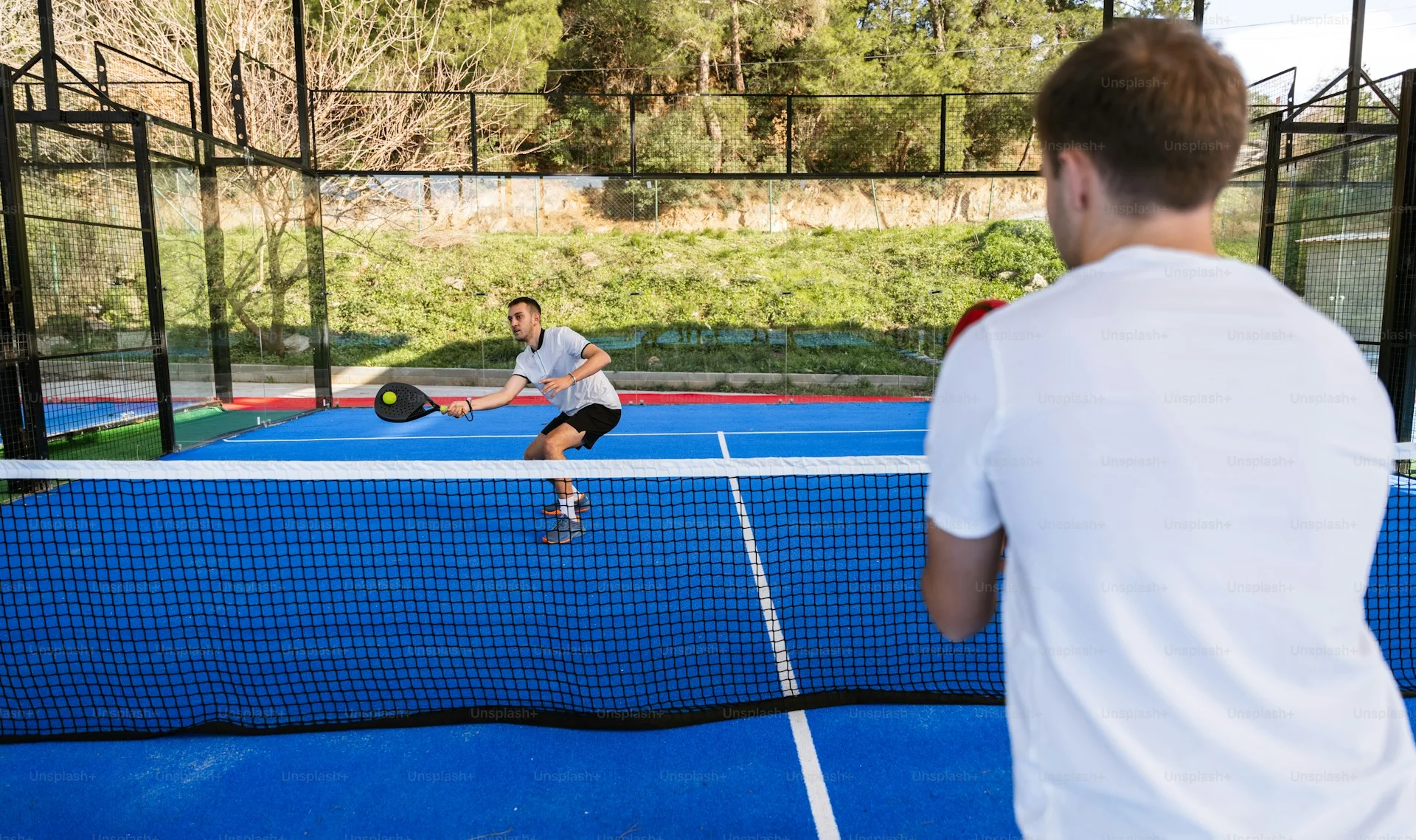
Photo: Yunus Tug / Unsplash
Photo: Yunus Tug / Unsplash / Unsplash LicenseClick a zone to learn more
Three Court Zones
The padel court is divided into three conceptual zones, each defining your role in the rally:
Green Zone (Attack)
Located 2–3 meters from the net. This is the zone of dominance: from here you control the rally and finish points. Shots from the green zone — volleys, bandejas, smashes — are the most effective.
Research on professional matches shows that approximately 36% of points are finished from the net zone, with 28.9% coming from volleys and 25.9% from smashes. The team that controls the net wins the vast majority of rallies.
Orange Zone (Transition)
Located between the service line and the net. This is the danger zone — “no man’s land.” Here you are too far from the net for an effective volley and too close for comfortable groundstrokes. Balls arrive at your feet, making it awkward to respond.
Rule: move through the orange zone, never stop in it. Move forward to the net or retreat behind the service line, but do not get stuck in between.
Red Zone (Defense)
Located behind the service line, in the back 2 meters of the court. This is the defensive zone: from here you play lobs, wall shots, and try to regain control of the rally. The objective from the red zone is not to win the point but to create conditions for moving forward.
Professional match analysis data shows that 41.4% of points are finished from the middle area of the court — confirming that the ability to transition between zones is critically important.
The Ideal: Both Players at the Net
The primary tactical goal in padel is to bring both players to the net. The statistics are clear: a pair at the net wins more than 70% of rallies. Here is why:
- Angles of attack. At the net, you can direct the ball to virtually any spot on the opponent’s court.
- Pressure. Opponents are forced to play accurately under pressure, increasing their error rate.
- Time. You are closer to the opponent, meaning they have less time to react.
- Finishing. Most “killing” shots — volleys and smashes — are executed from the net zone.
Ideal net position: both players stand 2–3 meters from the net, approximately 2–3 meters apart from each other. Knees slightly bent, racket held in front at chest level, ready for a split step.
Left Side and Right Side Roles
In padel, each side of the court implies a specific playing role. This is not a rigid rule, but understanding the specialization helps the pair work more effectively.
Right Side (Derecha)
The right-side player is the constructor. Their tasks:
- Consistency and accuracy. Build the rally, control the pace of play.
- Ball placement. Precise shots into uncomfortable zones, setting up attacks for the partner.
- Backhand through the center. Most shots through the center of the court fall on the right-side player’s backhand.
- Patience. The right side demands patient, positional play.
Left Side (Revés)
The left-side player is the finisher. Their tasks:
- Aggressive overhead shots. Bandeja, vibora, smash — the primary weapons of the left-side player.
- Center interceptions. The left player covers center lobs, which are often the most effective shots.
- Decisiveness. The left side requires the ability to make quick decisions and close out points.
- Forehand through the center. Center shots are most often played with the left player’s forehand.
[EXPERT OPINION] For beginner pairs, side selection is often straightforward: the more aggressive player goes to the left, the more consistent one to the right. Over time, you can experiment to find the optimal combination.
Moving as a Pair
One of the fundamental principles of padel positioning is synchronized pair movement. Imagine that you and your partner are connected by an invisible rope 3–4 meters long.
Rules for synchronized movement:
- Both forward. If one player approaches the net, the other must also move forward.
- Both back. If one retreats, the other retreats alongside.
- Same line. Both players should be on approximately the same horizontal line (equal distance from the net).
- Shift toward the ball. When the ball goes to the right corner, both players shift right. The left player covers the center.
What happens when synchronization breaks down:
If one player is at the net while the other is at the back wall, a “diagonal gap” forms between them. Opponents easily find this corridor and direct the ball where neither player can reach it.
As the legendary Fernando Belasteguin has said: positioning and mental focus are what separate a good pair from a great one. Shot technique matters, but without correct court placement, it loses half its effectiveness.
Communication
Positioning is impossible without constant communication between partners. In padel, you should be talking during every rally.
Basic calls:
- “Mine!” — you are taking the ball
- “Yours!” — the ball is your partner’s
- “Back!” — both retreat
- “Up!” — both approach the net
- “Switch!” — change sides
When communication is critical:
- The ball travels to the center between both players — who takes it?
- A lob goes over one player — retreat or leave it for the partner?
- After the serve — move forward or stay back?
Silence on the court is a sure sign of a beginner pair. Experienced players communicate not only through words but also through gestures and eye contact between rallies.
Common Mistakes
- Getting stuck in no man’s land. Between the service line and the net is the most disadvantageous position. Decide: forward or backward.
- Asynchronous movement. One player at the net, the other at the back wall. This creates defensive gaps that opponents easily exploit.
- Silence. Without communication, collisions and missed balls are inevitable, especially through the center.
- Standing still. Padel is constant movement. If you are standing and waiting, you are already losing position.
- Ignoring roles. Both players try to finish — nobody builds the rally. Or both play passively — nobody attacks.
- Too close to the net. Standing right at the net is a trap. The optimal distance is 2–3 meters: close enough for volleys, far enough to react to lobs.
All our knowledge is free. Creating it is not.
☕ Support on Ko-fi