Beginner Strategy in Padel
Padel is a game of patience and positioning, not power. Simple tactical principles allow beginners to beat physically stronger but tactically unaware opponents.
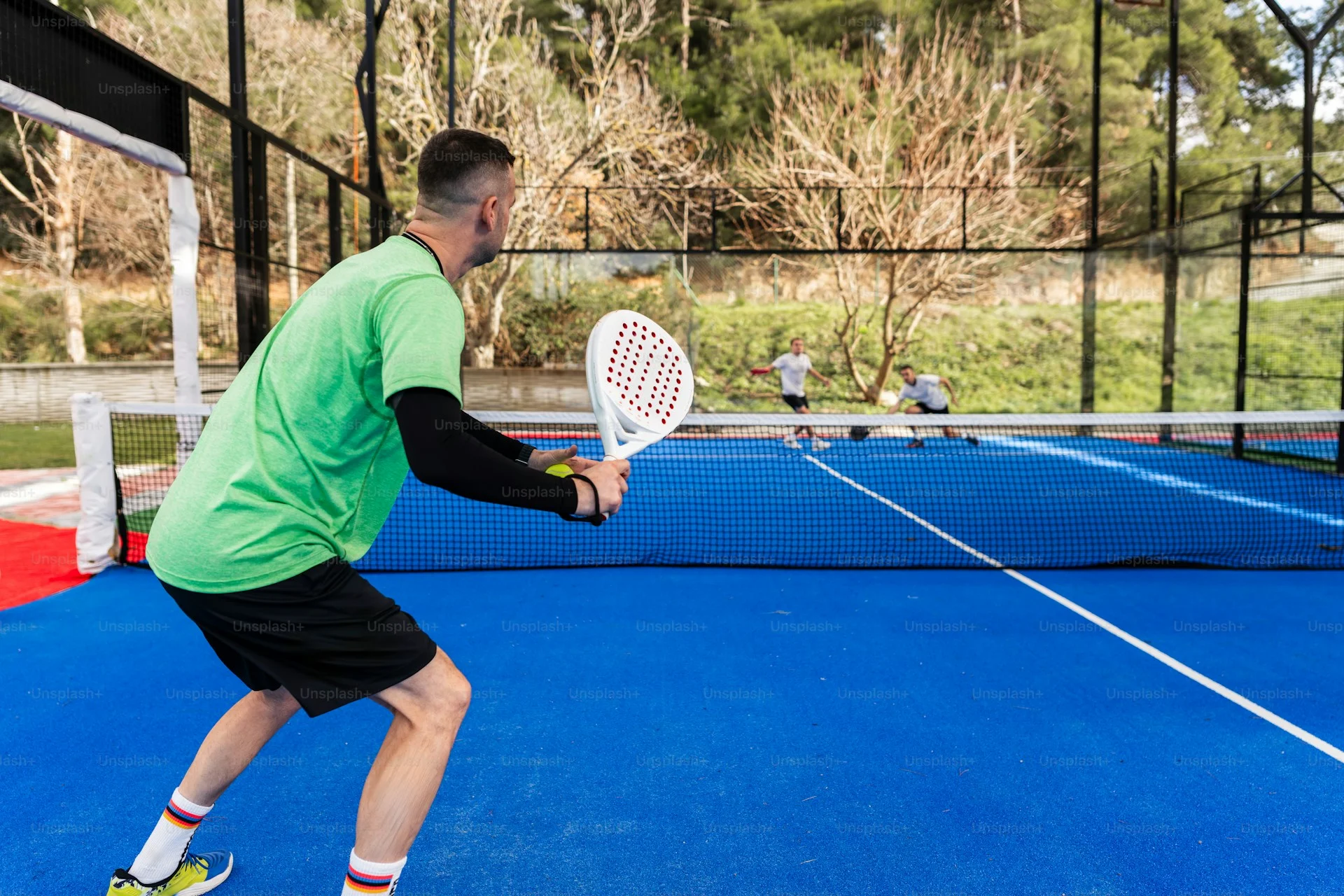
Photo: Yunus Tug / Unsplash
Photo: Yunus Tug / Unsplash / Unsplash LicenseConsistency Over Power
The most important principle for beginners: placement beats power. In padel, there is no point in hitting with all your might — the ball will bounce off the glass and return to your opponents with extra pace. You are literally giving them free speed.
As Babolat notes in their padel tactics guide: “Positioning is the bedrock of all padel strategies.” This is not tennis, where an ace can win a point. In padel, the player who makes fewer errors and more consistently returns the ball wins.
Practical rules for consistency:
- Hit at 70% of your maximum power — this is sufficient for a quality shot
- Aim for safe zones, not the lines
- A high ball (lob) is better than a risky flat shot
- When in doubt — play deep to the center of the opponent’s court
Professional match statistics confirm this principle: most points in padel are won not through “killing” shots but through opponent errors. Your job is to avoid mistakes and force the other side into making them.
The Goal: Get to the Net
If you remember only one tactical rule, let it be this: get to the net and stay there. The pair that controls the net wins the vast majority of rallies.
Why the net matters so much:
- At the net you attack; behind the service line you defend
- A volley from the green zone gives you the best attacking angles
- Opponents are forced to play more precisely and make more errors under pressure
- You control the pace of the rally
How to reach the net:
- Hit a quality deep shot (lob, deep drive)
- Make sure the shot puts pressure on the opponent
- Advance forward together with your partner
- Take up position 2–3 meters from the net
- Execute a split step and be ready for the response
[EXPERT OPINION] Do not approach the net after every shot. Only approach after a quality shot that forces the opponent to play from an uncomfortable position. Approaching after a weak shot is an invitation for the opponent to hit at your feet.
The Lob: Your Best Friend
The lob is a high, deep shot over the opponents standing at the net. For beginners, it is the most effective and safest shot in the arsenal.
Why the lob is so valuable:
- It is safe — a high trajectory means a large margin over the net
- It pushes opponents away from the net — they lose their attacking position
- It gives you time — while the ball travels in an arc, you can regroup
- It is simple to execute — no complex technique required
The ideal beginner lob:
- Direction: cross-court (diagonal) — this is the longest path across the court, meaning more margin for error
- Height: high enough that the opponent cannot intercept at the net (3–4 meters above the net)
- Depth: the ball should land past the service line, closer to the back wall
- After the lob: if it is deep — approach the net together with your partner
Playing to the Center
Hitting to the center of the opponent’s court is one of the most effective tactical tools at any level.
Advantages of hitting to the center:
- Minimum risk. The center is the farthest point from the sidelines. Even an inaccurate shot stays in court.
- Confusion between opponents. A ball to the center forces both opponents to decide who takes it. This provokes communication errors.
- No angles for the response. From the center, it is harder for opponents to create a sharp angle for attack.
- Hitting at the feet. If opponents are at the net, a shot to the center at their feet creates an extremely uncomfortable situation for them.
Aim to direct the ball between the opponents rather than at one specific player. The moment of uncertainty (“who takes it?”) is your advantage.
When to Attack, When to Defend
The decision to “attack or defend” is determined by your court position and the quality of the previous shot.
Attack when:
- You and your partner are at the net (green zone)
- The opponent is in an uncomfortable position (retreating, hitting off the wall, stretching for the ball)
- The ball arrives high and is convenient for an overhead shot
- You receive a short ball that can be played aggressively
Defend when:
- You and your partner are behind the service line (red zone)
- Opponents control the net
- The ball arrives deep and you are playing off the wall
- You have not reached the optimal position
In a transitional situation:
- Play a neutral shot — deep, to the center, without risk
- Wait for an opponent error or a weak response
- Gradually advance forward without forcing
Simple Game Patterns
Here are three basic patterns that work at every level:
Pattern 1: Lob — Approach — Volley
- From defense, send a deep cross-court lob
- While the ball is in the air, advance forward with your partner
- Take up position at the net
- Play a volley to the center or at the opponent’s feet
This is the most reliable way to seize the initiative. A deep lob forces the opponents to retreat, and you take their place at the net.
Pattern 2: Deep Center Shots — Wait for the Error
- Consistently send the ball deep to the center of the opponent’s court
- Do not take risks, do not try to “kill” the ball
- Wait for a weak response or an error
- When you receive a short ball — attack and approach the net
This pattern is particularly effective against beginners who start forcing shots and making errors themselves.
Pattern 3: Serve — Volley to Feet — Partner Intercept
- Execute a serve (moderate power, deep)
- Approach the net after the serve
- Direct the first volley at the receiver’s feet
- Your partner intercepts the weak response and finishes the point
This pattern requires coordination with your partner but is very effective.
Using the Walls
The walls are not your enemy — they are your ally. Many beginners panic when the ball flies toward a wall and try to intercept it on the way. This is a mistake.
Rules for using the walls:
- Let the ball bounce. The wall slows the ball and gives you extra time. Read more about this in Wall Play.
- Do not hit hard toward the wall. A powerful shot into the opponent’s back wall will rebound and give them a comfortable ball.
- Use the walls as reference points. If you are at the back wall — you are on defense. If your opponent is at the back wall — you should be at the net.
- Faster balls rebound farther. Control your shot power so the ball “dies” near the back wall rather than rebounding to mid-court.
[EXPERT OPINION] The best advice for beginners: after every wall rebound, play a high deep lob. It is safe, it works, and it gives you time to regroup. Do not try to play “beautiful” shots off the wall until you have mastered the basics.
Common Mistakes
- Hitting too hard. A powerful ball bounces off the glass faster and flies back to the opponents. You give them pace and time. Control your power.
- Ignoring position. Beginners think only about the shot, forgetting about position. Where you stand is more important than how you hit.
- Breaking the pair apart. One player approaches the net, the other stays back. This creates a “diagonal gap” in defense.
- Wall panic. The walls give you additional time. Do not fear them — use them.
- Impatience. Padel is a marathon, not a sprint. A rally can last 20–30 shots. Do not try to finish the point on the first hit.
- No plan. Every shot should have a purpose: create pressure, approach the net, force an error. Aimless shots are a gift to the opponent.
The light is on for free. But someone has to clean the lantern.
☕ Support on Ko-fi