Bandeja
The bandeja is a defensive overhead shot in padel, played when retreating from the net. It allows players to neutralize opponents’ lobs while maintaining their net position without excessive aggression.
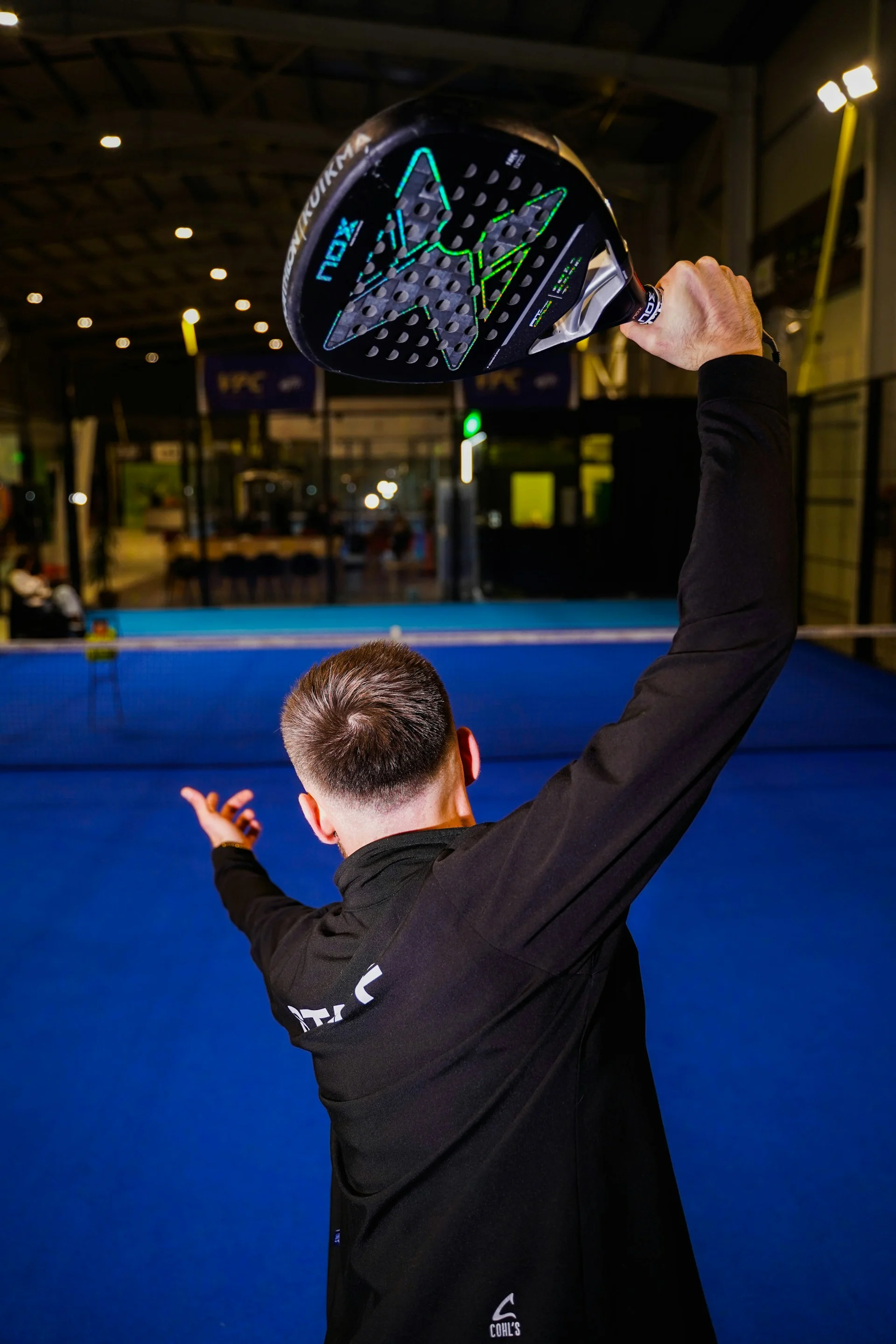
Photo: erjola qerimi / Unsplash
Photo: erjola qerimi / Unsplash / Unsplash LicenseWhen to Use
The bandeja is one of the most frequently used overhead shots in padel. It is applied when opponents hit a medium-height, medium-depth lob (globo) and you are positioned at the net or in the transition zone between the net and the service line.
Key situations for the bandeja:
- Answering a medium-height lob. The ball is high enough to hit overhead but not deep or high enough for a full smash.
- Maintaining net position. Unlike the smash, the bandeja does not require a full swing, allowing you to quickly return to your optimal net position.
- Controlling the rally tempo. When the situation does not allow you to finish the point aggressively, the bandeja lets you retain the initiative and continue applying pressure.
[EXPERT OPINION] Professional players use the bandeja far more frequently than the smash. According to coaching estimates, the bandeja-to-smash ratio in an average match can reach 3:1 or even 4:1. This underscores the defensive nature of padel as a sport.
Technique
Grip
The bandeja uses a continental grip — the same grip used for serves, volleys, and most overhead shots in padel. Imagine picking up the racket like a hammer: the V-shaped crease between the thumb and index finger sits on the top edge of the handle.
The continental grip provides:
- Natural racket face opening for slice
- The ability to quickly switch between shots
- Control over direction and depth
For more on grips, see Padel Grips.
Footwork
Proper footwork is the foundation of a successful bandeja:
- Shoulder turn. As soon as you identify the ball as a lob, turn sideways to the net. For right-handers, the left shoulder faces the net.
- Moving back. Travel toward the ball using shuffle steps or the crossover step (carioca step). Never run backward — it is both dangerous and inefficient.
- Hitting position. Position yourself so the ball is slightly in front of and to the side of you, roughly at front-foot level or slightly ahead.
- Recovery to the net. Immediately after the shot, move forward to return to your optimal net position.
Swing and Contact
- Preparation. Raise the racket behind your head, keeping the elbow at shoulder height. The non-hitting hand points at the ball — this helps track the trajectory and maintain balance.
- Contact point. Strike the ball above and in front of your head. The racket face is slightly open (tilted back) to impart slice. The racket moves from high to low and forward, but without a powerful swing.
- Slice. Apply backspin and a touch of sidespin to the ball. This slows the ball after the bounce and makes it harder for opponents to attack.
- Follow-through. After contact, the racket continues forward and down, but with a shorter motion than a smash. The overall swing amplitude of the bandeja is significantly smaller.
Ball Trajectory
Bandeja Trajectory
The bandeja has a characteristic trajectory that distinguishes it from the smash and the vibora:
- High arc. The ball travels along a parabolic path with considerable height.
- Deep landing. The aim is to land the ball in the back third of the opponents’ court, close to the back wall.
- Low bounce. Thanks to the slice, the ball stays low after bouncing and does not come far off the wall, making the return difficult.
Video Tutorial

Common Mistakes
Hitting too flat. Without slice, the ball bounces high off the floor and wall, giving opponents a comfortable ball to attack. Always add slice.
Losing net position. Many players stay deep after the bandeja instead of recovering to the net. The bandeja is a shot designed to maintain your dominant position — do not give up this advantage.
Too much power. The bandeja is not an aggressive shot. Trying to hit with maximum force leads to loss of control and accuracy. Focus on ball placement and slice, not power.
Hitting from an awkward position. If the ball has gone too far behind you, do not force a bandeja — switch to another shot (such as a lob) and rebuild your position.
Incorrect contact point. Hitting behind the head or too low reduces control and slice effectiveness. Always strive to meet the ball in front of you.
Bandeja vs Vibora
The bandeja is often confused with the vibora, but there are fundamental differences:
| Characteristic | Bandeja | Vibora |
|---|---|---|
| Purpose | Defense, control | Attack, pressure |
| Spin | Backspin (slice) | Sidespin |
| Trajectory | High arc | Flatter |
| Wall bounce | Low, “sticks” | Into the side glass |
| Difficulty | Intermediate | Intermediate-advanced |
Drills
Target bandeja. Place cones or targets in the back third of the court. A partner feeds balls overhead, and you hit bandejas aiming at the target zone. Start with sets of 10, aiming for 7+ on target.
Bandeja with recovery. Execute a bandeja, then take 3-4 quick steps toward the net and play a volley. This builds the habit of recovering to the net after every overhead.
Lob-bandeja rally. One player at the back wall hits only lobs; the other at the net responds only with bandejas. Switch roles every 5 minutes.
Depth control. Divide the back section of the court into three zones. Practice bandejas into each zone: short, medium, and deep. This develops distance awareness.
Bandeja under pressure. In a 2v2 game situation, agree to respond to all lobs with bandejas only (no smashes). This forces you to refine your technique under real match conditions.
All our knowledge is free. Creating it is not.
☕ Support on Ko-fi