Defending the Smash in Padel
Your opponent jumps and smashes. Your job is not to panic but to read the shot and choose the right response: block, reset lob, or counter-attack.
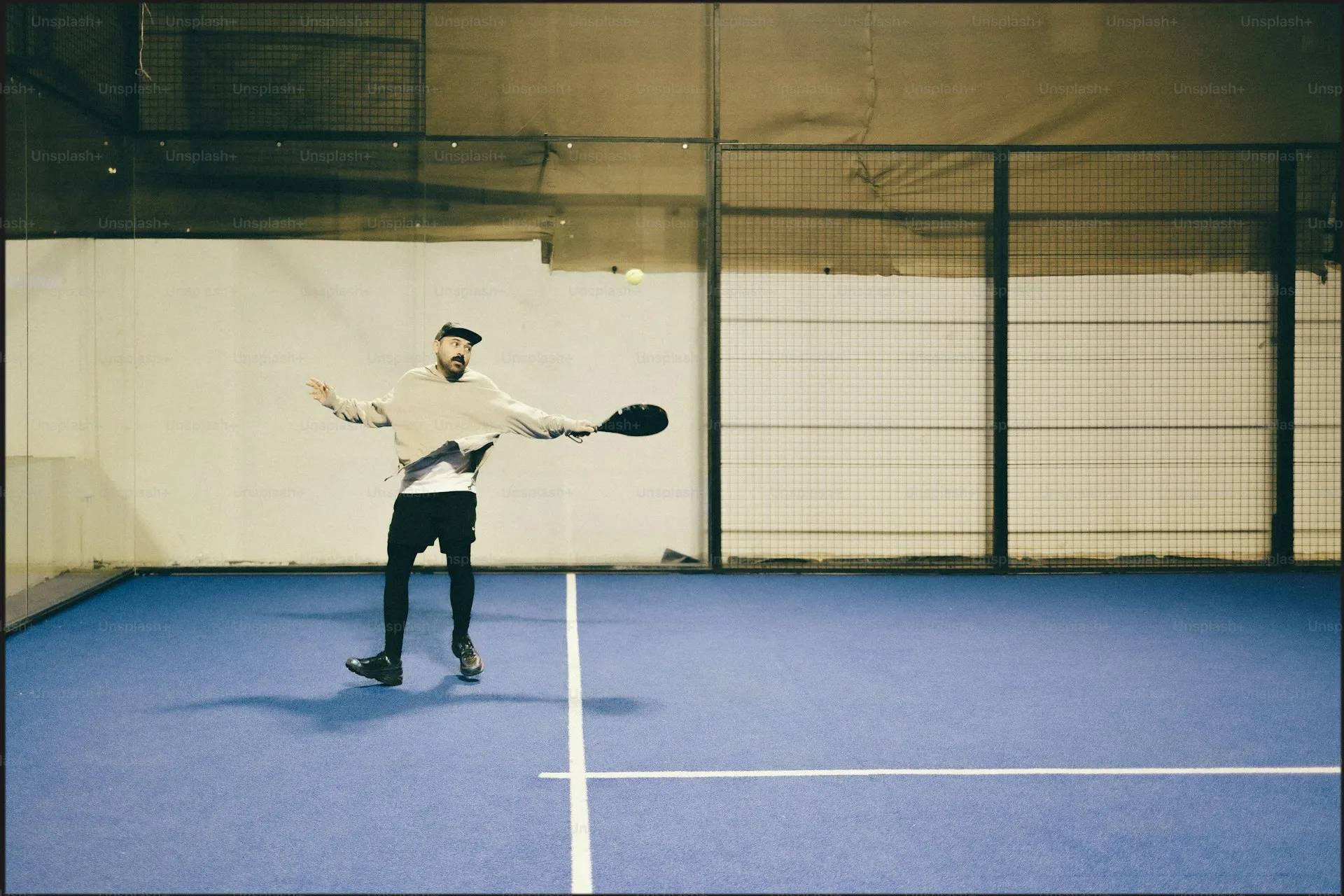
Photo credit
Photo by Antonio Verdín on Unsplash
The Principle: Position → Read → Choose
Defence against the smash rests on three elements:
- Position — where you stand
- Read — what the opponent is about to do
- Choice — block, reset, or counter
Positioning
Base Position
- One step from the back wall, racket in front of you
- This gives space for reaction and reading glass rebounds
- Roughly 1 metre from the side wall
- Low stance, knees bent, weight on the balls of the feet
- Facing the striking player
Default plan: “One step from the wall, racket up front, first response — block.” When you have a default answer, the mind stays calm.
Reading the Smash
Visual Cues
| Opponent’s preparation | Likely shot |
|---|---|
| High backswing, extended arm | Powerful smash |
| Short preparation | Drop shot or bandeja |
| Off balance, leaning back | Defensive lob or soft return |
| Wrist-heavy preparation | Rulo or vibora with sidespin |
| Slow, relaxed preparation | Controlled shot |
Rule: read the lob early and move quickly — anticipate, do not just react.
Three Response Options
A. Block (Primary Response)
The highest-percentage answer to hard, low smashes.
- You do not hit — you absorb the speed and redirect
- Short backswing, softened grip pressure (“soft hands”)
- The racket angle directs the ball low cross-court or down the line
- Goal: keep the ball low so the opponent cannot finish
B. Reset Lob
If the smash is not a clean winner and you have time:
- A high, deep lob to reclaim position
- Safely over the net players, deep towards the back wall
- Use when you have balance and time to prepare
C. Counter-Attack
Only when the smash is medium-paced and the ball sits up at a comfortable height:
- The riskiest option
- Apply only when you read the situation
- Goal: seize the initiative
Decision Rule
Hard/low smash → block. Time and balance → lob. Medium pace, ball sits up → counter.
Playing Off the Wall
After a smash the ball often rebounds off the back or side wall. This is your chance:
- Let the ball rebound off the wall
- Step back 1–2 metres for space
- After the rebound, play a block or lob
Common Mistakes
Standing right against the wall. No space for a swing. One step away.
Panicking. The smash looks scarier than it is. Most smashes can be handled with a block.
Trying to counter everything. Counter-attack only on medium smashes. Hard smash = block.
Standing upright. A low stance gives better reflexes and stability.
Ignoring the walls. A ball off the wall is extra time. Use it.
Drills
Block drill. Partner smashes from the net; you stand at the back wall and block. 20 balls, focus on soft hands.
Read → choose. Partner alternates hard smashes, bandejas, and drop shots. You choose the response: block, lob, or counter. 15 balls.
Wall play. Partner hits balls into the back wall; you play after the rebound. 10 balls on each side.
Match defence. 2 vs 2, one pair attacks exclusively with smashes, the other defends. Goal: keep the ball in play for 3+ shots after the smash.
The light is on for free. But someone has to clean the lantern.
☕ Support on Ko-fi