Footwork in Padel
Footwork is the invisible foundation of every shot in padel. Good movement allows you to always reach the right spot on court and execute shots from an optimal position.
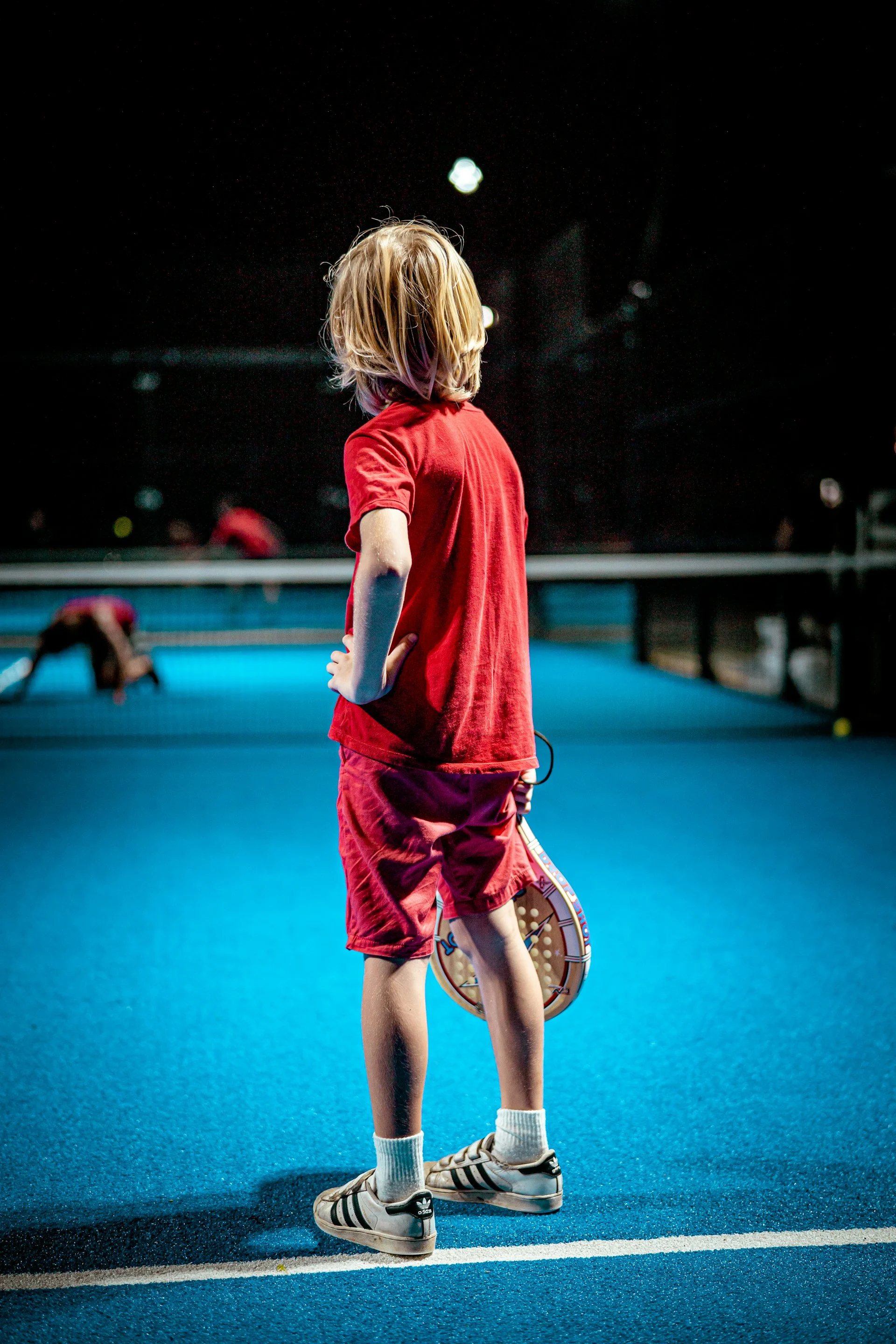
Photo: Artur Kornakov / Unsplash
Photo: Artur Kornakov / Unsplash / Unsplash LicenseWhy Footwork Matters
Padel is a game of positioning, not brute force. Even perfect stroke technique is useless if you have not reached the right position. On a compact 10-by-20-meter court, movements are shorter than in tennis but happen significantly more often and require greater precision.
Good footwork solves several problems simultaneously: you reach the optimal position for each shot, maintain balance during contact with the ball, recover quickly after shots, and control court zones together with your partner. According to coaching estimates, 80% of mistakes made by beginners are related not to hand technique but to incorrect foot positioning.
The Split Step
The split step is the foundational element of readiness — a small hop in place performed before every opponent’s shot. It is the cornerstone of all footwork in padel.
How to execute:
- As your opponent begins their swing, make a small jump (literally 3–5 cm off the surface).
- Land on both feet simultaneously, on the balls of your feet, with knees slightly bent.
- Body weight on the balls of your feet, ready to move in any direction.
The split step activates your leg muscles and allows an instant reaction to the ball’s direction. Without it, you will get “stuck” in place and consistently arrive late to the ball.
[EXPERT OPINION] The split step is a habit that must be built consciously. In the beginning, say “hop” every time your opponent hits the ball and jump simultaneously. After a few training sessions, it will become automatic.
Lateral Movement
Lateral movement is the primary way of getting around in padel. You move with side shuffles along the net or the back wall, staying face-on to your opponent.
Shuffle technique:
- Feet shoulder-width apart, knees slightly bent
- The first step is taken by the foot closest to the direction of movement
- The trailing foot slides to join but never crosses the lead foot
- Center of gravity stays low, no “bouncing”
- Feet do not lift high off the surface — use sliding steps
Key rule: avoid crossover steps during lateral movement at the net. Crossed feet rob you of balance and the ability to react instantly to a shot. Crossover steps are only acceptable during long runs to the back wall when you need to cover a large distance.
Approaching the Net
Moving forward to the net is one of the most important tactical movements. After a quality shot (a deep lob, an accurate drive), you and your partner should advance forward and take up an attacking position at the net.
How to approach the net correctly:
- Hit a quality shot — deep, uncomfortable for your opponent.
- Immediately after the shot, begin moving forward.
- Move with small steps, ready for a split step.
- Execute a split step at the moment your opponent makes contact.
- Take up position 2–3 meters from the net.
- Move forward together with your partner — you are connected by an “invisible rope.”
A common mistake is approaching the net after a weak shot. If your shot did not put pressure on the opponent, moving forward will backfire: you will be forced to play from an uncomfortable position.
Retreating Backward
Retreating is no less important a skill than moving forward. When opponents hit a deep lob or a high shot, you need to move back to the rear wall quickly.
Retreating technique:
- Turn sideways (not with your back!) to the net
- Use crossover steps for rapid backward movement
- One hand controls the racket, the other helps with balance
- Do not run to the ball — move to the point where the ball will be after the bounce
- Let the ball bounce off the wall — use wall play to your advantage
[EXPERT OPINION] When retreating, the most common mistake is trying to hit while running with your back to the net. It is better to run past the ball, stop, turn, and hit from a balanced position.
Positioning after retreating:
If you were forced to retreat, settle behind the service line (approximately 1.8–2.5 m from the back wall). This gives you reaction time and space to use the walls. Do not get stuck in “no man’s land” between the service line and the net — this is the most vulnerable position on the court.
Video Tutorial
Common Mistakes
- Flat feet. Stand on the balls of your feet, not your heels. Heels on the ground equals slow reaction.
- No split step. Without a split step, your first step to the ball will be 0.3–0.5 seconds slower. On a compact court, that is decisive.
- Crossing feet at the net. You lose balance and cannot change direction quickly.
- Approaching the net alone. If you move up while your partner stays back, a “diagonal gap” forms in your defense. Move together.
- Running to the ball instead of the position. Do not chase the ball — move to where the ball will be. This is a fundamental difference in wall sports.
- High center of gravity. Straight legs while moving are a sure path to late reactions. Keep your knees slightly bent.
Exercises
- Split step on command. A partner stands opposite and claps their hands. On each clap, execute a split step and a first step in a random direction. 3 sets of 20 repetitions.
- Shuffles along the net. Stand at the net and shuffle from one side of the court to the other. Do not cross your feet. A partner feeds balls alternately left and right. 5 minutes without rest.
- T-drill. Start from the center of the back wall. Sprint forward to the net, touch it, shuffle right, then left, return backward. Repeat 10 times.
- Approach and retreat. A partner alternates between short feeds (you approach the net) and deep lobs (you retreat). Focus on smoothness of movement, not speed. 10 minutes.
- Shadow practice with racket. Without a ball, simulate a full rally: split step — step right — volley — split step — step left — volley — retreat — wall shot — move forward. 3 sets of 2 minutes.
If this article was useful — help us write the next one.
☕ Support on Ko-fi