Intermediate Training Drills
A set of eight targeted drills for players who have mastered the basics and are ready to step up their game. Focus areas include net play, overhead shots, reading the walls, and pair coordination.
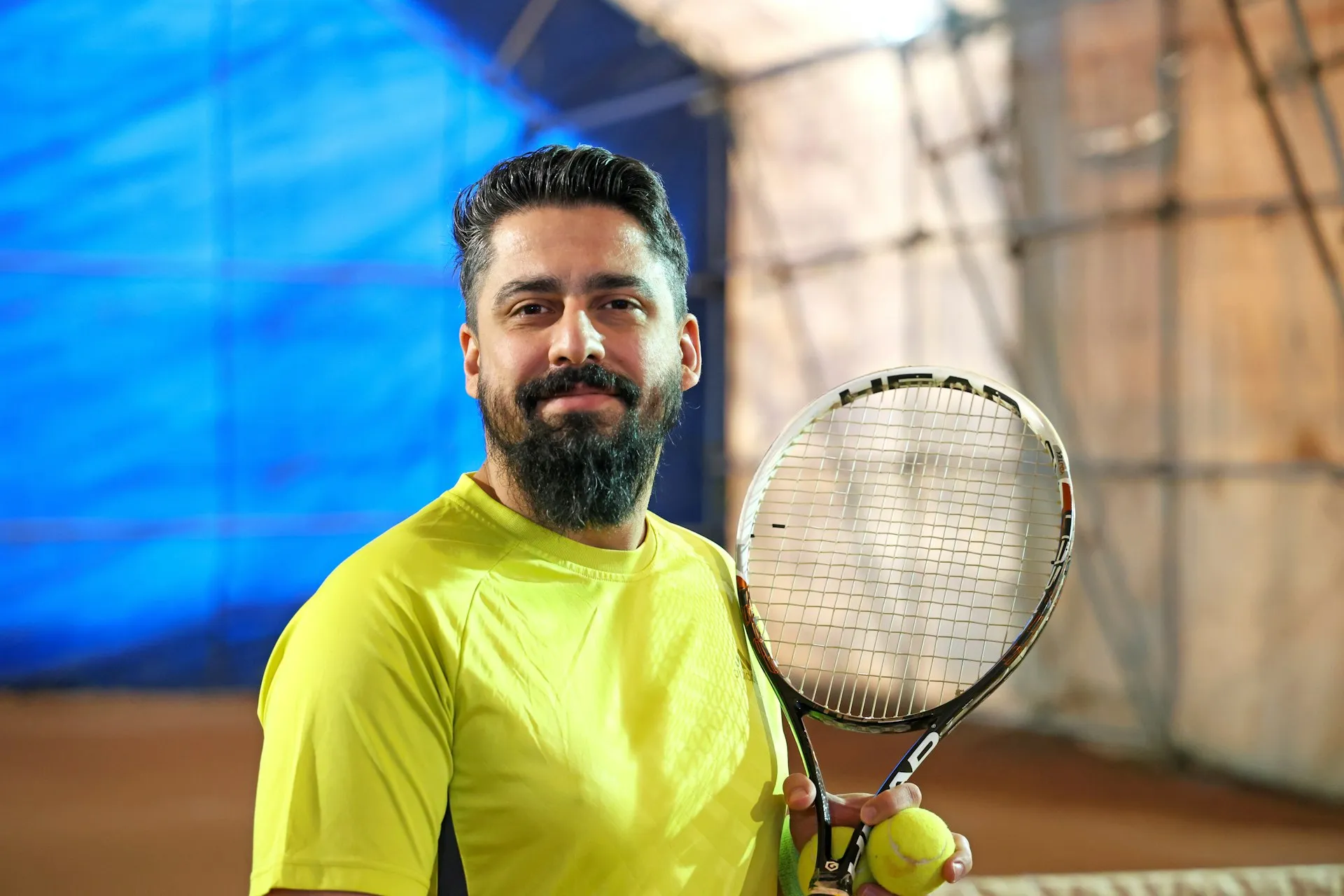
Photo: Babak Eshaghian / Unsplash / Unsplash License
Preparation
Before starting, make sure you have everything you need:
- A padel racket — for intermediate players, teardrop shapes work well
- Balls — at least 6 (two cans)
- Court shoes with lateral support
- Cones or markers — 4–6 (for zone marking)
- A partner (most drills are designed for two)
- Water bottle
Recommended session length: 60–90 minutes. Each drill runs for 8–12 minutes but can be extended as needed.
Drill 1: “3 Deep + 1 Drop”
Goal: develop depth control on the volley and learn to change pace.
Setup: both players at the net, facing each other. One is the “leader”, the other the “responder”.
Execution:
- The leader plays 3 deep volleys towards the partner’s baseline
- On the 4th shot — a drop volley; the ball should land just beyond the net
- The partner tries to return all 4 balls while staying at the net
- After a set of 4 shots — swap roles
Duration: 10 minutes (5 min each).
Variations:
- Advanced: alternate the side of the drop volley (forehand/backhand)
- The leader chooses which of the 4 shots becomes the drop volley
Drill 2: Overhead Rotation
Goal: automate the switch between bandeja and vibora.
Setup: one player at the net, the other on the baseline. The baseline player feeds lobs.
Execution:
- The baseline player sends a lob
- The net player executes a bandeja (backspin, high trajectory)
- Next lob — vibora (sidespin, low trajectory)
- Alternating: bandeja → vibora → bandeja → vibora
- Every 8 shots — swap roles
Duration: 12 minutes.
Variations:
- The baseline player calls the shot type out loud: “B!” (bandeja) or “V!” (vibora)
- Add a third option — smash on a short lob
Drill 3: Net-to-Back Transition
Goal: practise switching between attack and defence, learning to move quickly across the full length of the court.
Setup: two players on one side. One starts at the net, the other on the baseline.
Execution:
- The net player hits a volley
- The opponent (on the other side) responds with a lob
- The net player retreats to the back wall and takes the ball after the bounce
- Sends a lob back and moves forward to the net
- The cycle repeats: net → retreat → back wall → approach the net
Duration: 10 minutes (swap after 5 minutes).
Variations:
- Add a split-step before every shot
- The opponent alternates lobs and low shots — the net player decides: stay or retreat
Drill 4: Wall Reading
Goal: improve reading of rebounds from the back and side walls.
Setup: one player near the back wall, the other on the opposite side (or a coach with a ball basket).
Execution:
- The partner directs balls into the back wall at varying speeds and angles
- The receiver reads the bounce and plays the ball after the wall rebound
- Set 1 (5 min): back wall only — return to the centre
- Set 2 (5 min): side wall + back wall (the ball hits the side glass first, then the back wall, or vice versa)
- Key point: don’t rush — let the ball come off the wall, get into position
Duration: 10 minutes.
Variations:
- The partner varies the power of feeds (soft / hard)
- The receiver must return the ball with a lob — adding a tactical element
Drill 5: Cross-Court Volley Exchange
Goal: increase accuracy and consistency of diagonal volleys.
Setup: both players at the net, each on their own side. Player A stands on the left, Player B on the right (cross-court diagonal).
Execution:
- The rally starts with a soft diagonal volley
- Both players keep the ball strictly cross-court
- Target: 20 consecutive shots without an error
- Focus: body rotation, soft hands, directional control
- After 20 shots — switch diagonal (both move to the opposite side)
Duration: 8 minutes.
Variations:
- One player hits only forehand volleys, the other only backhand
- Add acceleration: every 10 shots — increase the pace
Drill 6: Lob Defence → Counter-Attack
Goal: learn to transition from defence to attack after a deep lob from the opponents.
Setup: Pair A at the net, Pair B on the baseline. Pair B starts with a lob.
Execution:
- Pair B plays a deep lob over Pair A
- Pair A retreats to the back wall and takes the ball after the bounce
- Pair A returns the ball with a low shot or a counter-lob
- Pair A’s objective: regain the net position within 2–3 shots
- The rally continues until an error
Duration: 12 minutes (swap roles after 6 minutes).
Variations:
- Pair B may choose: lob or low shot — Pair A must read the intention
- Restrict the counter-attack to down-the-line shots only (no cross-court)
Drill 7: Synchronised Pair Movement
Goal: build coordinated movement as a pair — a key skill in padel tactics.
Setup: a pair on one side of the court. Cones placed at 6 positions: 2 at the net, 2 on the baseline, 2 in the middle.
Execution:
- Without the ball: one player moves right — the other mirrors the movement in the same direction
- One retreats — the other retreats in sync, maintaining the gap between partners (~3 metres)
- With the ball: the pair plays a 2v2 rally, focusing on synchronised movement
- Rule: the distance between partners must not exceed 3–4 metres
- After each rally — brief analysis: “Were we together?”
Duration: 10 minutes (3 min without the ball + 7 min with the ball).
Variations:
- One partner leads, the other follows. Then swap
- A coach freezes the rally at a random moment — the pair evaluates their positioning
Drill 8: Match-Play Scenarios
Goal: apply all skills in near-match conditions.
Setup: standard 2v2 positions. Each rally starts from a specific situation.
Execution:
Scenario A — “Serve + Net Approach”:
- The server executes a serve and immediately moves to the net
- The server’s partner is already at the net
- The rally continues until the point ends
- Objective: hold the net position for as long as possible
Scenario B — “Baseline Defence”:
- The pair starts on the baseline, opponents at the net
- Task: win the net back in the fewest shots possible
- Use lobs, low shots to the feet, chiquita
Scenario C — “First to 3 Points”:
- Short matches: first to 3 points
- The losing pair does 5 squats (motivation)
- Each new rally starts with a serve
Duration: 15 minutes (5 minutes per scenario).
Session Structure
Recommended plan for a 90-minute session:
| Phase | Time | Content |
|---|---|---|
| Warm-up | 10 min | Light jog, dynamic stretching, ball bouncing |
| Drill 1 | 10 min | “3 Deep + 1 Drop” |
| Drill 2 | 12 min | Overhead rotation |
| Rest | 2 min | Water, recovery |
| Drill 3 | 10 min | Net-to-back transition |
| Drill 4 | 10 min | Wall reading |
| Drill 5 | 8 min | Cross-court volley |
| Rest | 2 min | Water, recovery |
| Drill 6 | 12 min | Lob defence → counter-attack |
| Drill 7 | 10 min | Synchronised pair movement |
| Drill 8 | 15 min | Match-play scenarios |
| Cool-down | 5 min | Static stretching, debrief |
[EXPERT OPINION] You do not need to complete all 8 drills in a single session. Pick 4–5 drills, focusing on the aspects that need the most attention. Rotate the selection from session to session.
The light is on for free. But someone has to clean the lantern.
☕ Support on Ko-fi